
What Kind of Life Do I Want?
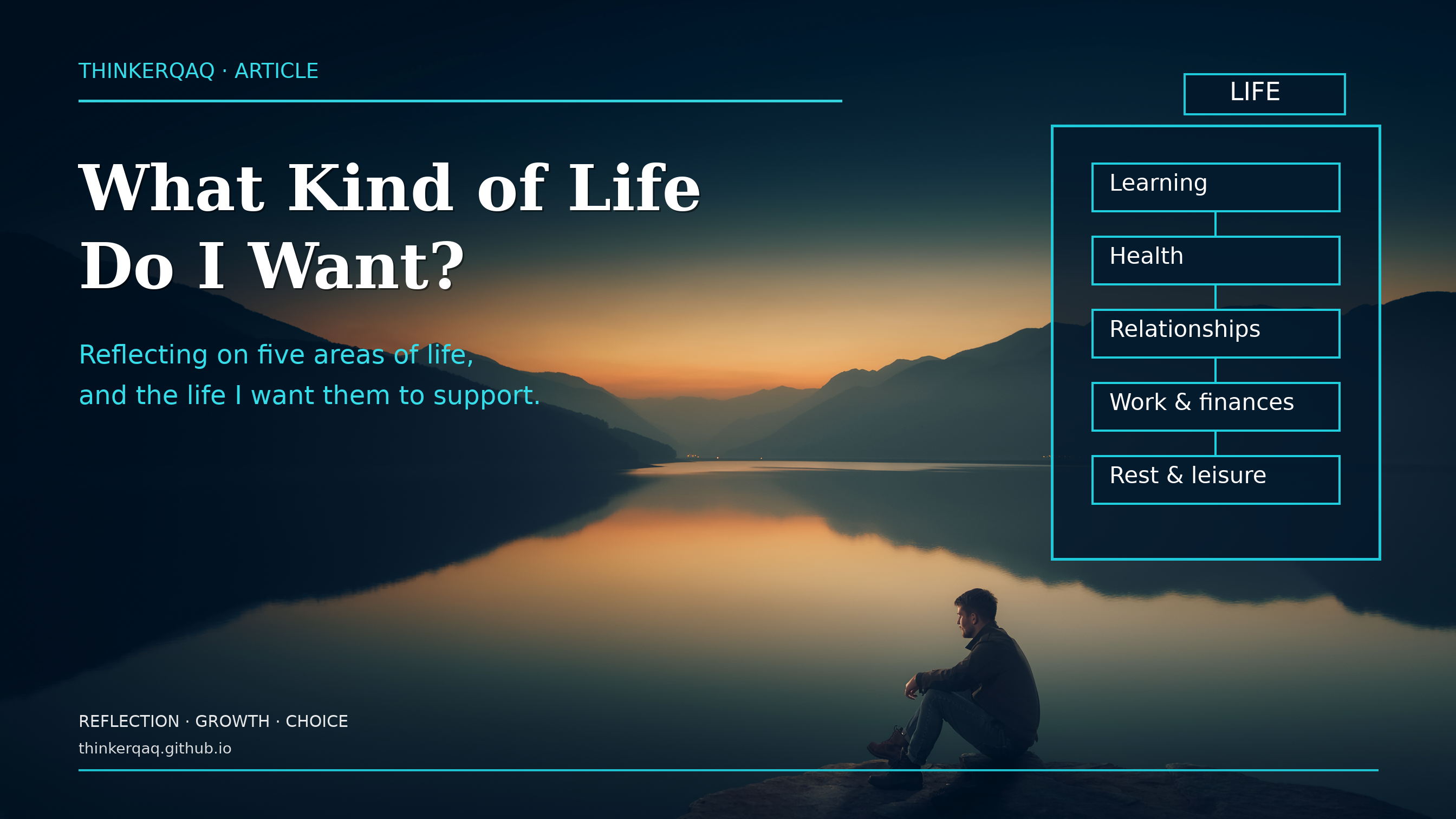
A reflection on five areas of life—learning, health, close relationships, work and finances, and entertainment and rest—and the kind of life I want them to support.
1. Introduction
A few years ago, I wrote an article titled “What I Think About When I Feel Anxious: Life and Planning.”
At the time, I tried to organize my understanding of life by looking at the course of a person’s life, the factors that shape it, and the role of planning. I believed that our time is limited, but through learning and reflection, we can keep adjusting how we understand the world. Based on that understanding, we can decide how to spend our time and, to some extent, shape our lives.
In that article, I identified five areas worth paying attention to over the long term: learning, health, love, work, and entertainment. I also argued that their priorities should change at different stages of life.
Recently, I revisited the article. I still agree with those five areas, but there were two questions I had not answered.
The first question is: Why these five areas? Why learning, health, love, work, and entertainment rather than something else?
The second question is: What kind of life am I ultimately trying to pursue by investing in these areas? If I simply allocate time to different areas, keep learning and working, and continue completing goals, where are these activities supposed to lead me? What kind of life do I actually want to live?
This article explores those two questions and builds on my earlier reflections to clarify my current understanding of life.
These thoughts are only my current understanding. Whether I will arrive at different answers in the future is something I will leave to my future self.
2. Why These Five Areas?
2.1. Learning
I value learning first because it can change how I understand the world and expand both my capabilities and my options.
Different people can look at the same problem and see very different solutions. The more knowledge a person has and the more perspectives they can draw on, the more likely they are to notice possibilities they previously could not see. When I also learn the methods and skills needed to solve a problem, those possibilities have a chance to become real.
For example, learning a new technology does not just mean mastering another tool. It may allow me to solve problems I could not solve before, enter an unfamiliar field, or even create new career opportunities. Learning cannot guarantee that every possibility will become reality, but it can give me more options instead of leaving me limited by what I do not know or cannot do.
Second, learning is enjoyable in its own right.
I am curious about unfamiliar things, and I enjoy gradually understanding a problem that once made no sense to me. When scattered pieces of knowledge begin to form a coherent picture, or when careful analysis finally resolves a difficult problem, I feel a sense of satisfaction.
That satisfaction does not depend entirely on whether learning produces a practical return. Even if certain knowledge does not immediately lead to income, work results, or other tangible benefits, I am still willing to spend time on it if it satisfies my curiosity and deepens my understanding of the world.
Learning therefore has two kinds of value for me: it expands my understanding and abilities, giving me more choices; and the process of exploring the unknown and understanding problems is itself something I want to keep doing.
2.2. Health
Health is first of all a foundation for everything else.
Learning, working, and building close relationships all depend on our physical and mental condition. If I regularly lack sleep, feel physically unwell, or remain in a poor psychological state, I may not have enough energy to do the things I want to do. When health problems arise, I may have to devote a great deal of time and attention to dealing with them, leaving less freedom to arrange the rest of my life.
From this perspective, maintaining health is not just about becoming more productive. It is also about preserving my ability to act, so that I can continue doing the things that matter to me.
But health is not valuable only because it helps us achieve other goals. Health is itself part of quality of life.
Our physical condition directly affects how we experience everyday life. With good physical fitness, we can exercise, travel, and try different activities more easily. With a relatively stable mental state, we may be better able to enjoy life, cope with stress, and build good relationships. By contrast, if we are constantly exhausted or in pain, progress in other areas may not be enough to make life satisfying.
I therefore want to take care of both my physical and mental health through reasonable exercise, sufficient sleep, a healthy diet, and seeking professional help when necessary.
That does not mean I need to pursue a perfect body or devote a huge amount of time and energy to fitness and health maintenance. Health also requires a reasonable balance between investment and benefit. If improving my physical condition comes at the expense of sleep, other important activities, or my peace of mind because I become overly focused on health metrics, I may have lost sight of the original purpose.
I want to maintain a level of health that supports the life I want to live, not turn health itself into a goal that can never be completed.
2.3. Close Relationships
Human beings are social creatures. Beyond our survival and material needs, we also need connections with other people—understanding, acceptance, companionship, and support.
Close relationships meet these emotional needs. When we face difficulties, we want someone we can talk to. When something good happens or we make progress, we want someone to share it with. In everyday life, we also want people who understand our thoughts and care about what we are going through. These connections give us a sense of belonging and remind us that we do not have to live in isolation.
Close relationships include family, friendship, and romantic love. Each has its own characteristics. Family relationships carry emotional bonds and support within a family. Friendships grow through mutual understanding, trust, and shared experiences. Romantic relationships usually include romantic attraction and a desire to build a partnership with another person. These relationships can meet some of the same needs, but they cannot fully replace one another.
I value close relationships not only because people need a sense of belonging, but also because I want to share my life with people who matter to me, understand one another, and both give and receive support. In particular, I hope to build a genuine and stable romantic relationship in the future: one in which we share happy experiences, understand and accompany each other, and face life’s difficulties together.
2.4. Work and Finances
The most direct function of work is to help us obtain financial resources. Money allows us to meet basic needs and prepare for the future.
More importantly, our financial situation affects the range of choices available to us. If I have to accept work I do not want simply to cover basic living expenses, my options in both career and daily life become more limited.
By contrast, if I have savings and the ability to earn a sustainable income, I have more freedom to choose suitable work or leave an environment that does not suit me.
Of course, wealth cannot solve every problem, but a financial foundation can reduce some of the constraints imposed by reality.
I therefore care about work and finances not only to earn more or advance my career, but also to build professional capabilities and financial resources so that I can gradually gain more autonomy over my choices.
2.5. Entertainment and Rest
If the previous areas concern capabilities, health, relationships, and finances, entertainment and rest address another question: Can I enjoy life itself?
Imagine someone who spends every day learning, working, exercising, and completing goals. Everything has a clear purpose, and every moment is scheduled. From the perspective of efficiency, such a life might look productive, but it does not necessarily feel satisfying.
Entertainment and rest help us recover our energy. They also let us experience things that do not have to produce a result, such as listening to music, watching films, playing games, traveling, or simply sitting quietly for a while.
These activities may not generate practical returns, but that does not make them worthless. We do not need to justify every activity in life in terms of productivity.
I want not only to pursue goals seriously, but also to enjoy moments when I do not need to prove anything or produce anything.
2.6. Summary
- Learning and creation: How to understand the world, expand my capabilities, and turn understanding into results.
- Health: How to maintain my physical and mental condition and preserve my ability to act.
- Close relationships: How to build genuine emotional connections with other people.
- Work and finances: How to obtain practical resources and expand my freedom of choice.
- Entertainment and rest: How to recover my energy and enjoy life itself.
These areas are not independent of one another. Work can create opportunities for learning and creation; close relationships can affect our physical and mental well-being; and entertainment can sometimes help us learn new things.
However, each area addresses a different need, and they cannot fully substitute for one another. Financial resources cannot replace close relationships, continuous learning cannot replace rest, and good health does not automatically make life fulfilling.
I use these five areas as dimensions for examining my life. I want to pay attention not only to whether I am making progress, but also to whether I have good physical and mental health, genuine emotional connections, and the ability to enjoy life.
Once these areas are clear, the next question is how I should choose when they conflict.
3. How Should I Choose When Different Priorities Conflict?
3.1. Why Not Give the Five Areas a Permanent Ranking?
One natural approach is to assign the five areas a fixed order of priority, such as health first, work second, and learning third.
But the importance of different activities changes with the situation.
For example, learning matters, but if a family member suddenly faces an urgent problem, dealing with it first is clearly more reasonable. On the other hand, if the person simply wants to chat while I am working on something that requires concentration, I can suggest talking after I finish that part.
I therefore do not think priority should be determined only by which area an activity belongs to. The specific circumstances also matter.
3.2. Daily Decisions: Handle What Is Important and Urgent First
For example, suppose I am learning a new technology and a family member comes over to talk. Should I keep studying or stop and spend time with them?
I need to understand the situation first.
If the family member needs to discuss something important or has been going through a difficult time, I can put my studies aside and listen.
If it is just an everyday conversation and I am working through a problem that requires concentration, I can explain that I will talk with them after finishing that part.
But if I use “I’ll talk to you when I’m less busy” every day to postpone time with my family, the problem is no longer about a single decision. It becomes a question of whether I am consistently neglecting close relationships.
This illustrates why individual decisions and long-term planning need to be considered separately. Prioritizing work on a particular day does not mean work is always more important than relationships. But if I have spent months without making time for my family, I need to reconsider how I am arranging my life overall.
3.3. Long-Term Review: Is My Life Moving in the Direction I Want?
Daily decisions help me determine what to do first in the moment. A long-term review asks a different question: after some time has passed, is my life moving toward the direction I want?
I can review it from four perspectives.
First, basic needs and boundaries. Are my basic living needs met? Is my health in an acceptable condition? Have I been neglecting important responsibilities for too long?
Second, progress. Am I taking concrete action on the things I truly care about? If I want to keep learning and creating, I should check whether I have been learning, practicing, or producing work. If I want to build close relationships, I need to take real steps rather than leave the desire as an idea.
Third, the cost. What have I sacrificed for my current goals, and are those sacrifices acceptable? Reducing entertainment time for a short period may be reasonable, but sacrificing sleep, health, and important relationships over the long term calls for a reassessment.
Fourth, adjustment. If my current life differs from the life I want, what should I change in the next stage? I may need to spend more time learning, give rest greater priority, or create more opportunities to connect with other people.
The purpose of reviewing my life is not to keep adding tasks. It is to identify problems and adjust how I actually live.
3.4. Summary
Daily decisions help me handle immediate conflicts, while long-term reviews help me check the overall direction. Together, they can prevent a situation in which every individual choice seems reasonable, yet the life I end up living is not the one I wanted.
4. What Kind of Life Do I Want to Pursue?
4.1. The Freedom to Choose How I Live
I want to arrange my life according to my genuine wishes, rather than being forced to accept choices I do not want because I lack financial resources, professional skills, or other necessary conditions.
For example, I want to be able to choose work that suits me instead of enduring an unreasonable work environment just to cover basic expenses. I also want to decide how to spend my time rather than being pushed around by external demands every day.
Of course, autonomy does not mean that I can do anything I want. Everyone is constrained by their abilities, financial circumstances, family responsibilities, social environment, and factors beyond their control.
Within the limits of reality, I want to gradually expand my range of choices by continuing to learn, building professional skills, improving my financial situation, and maintaining my health.
4.2. Stable Close Relationships
I want to maintain stable relationships with my family and friends, and I also hope to build a stable romantic relationship in the future.
I want us to understand, trust, and support each other—to share happy moments and accompany one another through difficult times.
4.3. A Stable Source of Income
I want to build a stable source of income through my professional abilities and the value I create, while gradually accumulating enough savings.
Financial security is not only about meeting everyday needs. It can also reduce my dependence on a single job or source of income, giving me more room to respond to career changes and make life choices.
4.4. Physical and Mental Health
I want to maintain good physical and mental health through reasonable exercise, sufficient sleep, and healthy habits. This will help me have the energy to learn, work, build relationships, and experience life.
I am not pursuing a perfect physical condition. I want my health to support the life I hope to live over the long term.
4.5. Rest and a Sense of Ease
I want to pursue my goals seriously without being tense all the time.
I can work hard, learn, and make progress, but I also want to stop when appropriate and enjoy music, films, travel, and moments that do not need to produce anything.
I do not want to turn everything into a task, nor do I want to judge whether I am doing well enough by constantly comparing myself with others. I want to have both ambition and the ability to enjoy life.
5. Conclusion
My thoughts have become clearer as I have worked through these questions.
I want to gradually gain more freedom to choose how I live, maintain stable close relationships and a reliable source of income, stay healthy, and have the space to rest, relax, and enjoy life.
This means that I will continue building professional skills and financial resources for the future, while also investing time in learning and creation, close relationships, entertainment, and rest. I do not expect myself to excel in every area at all times. I want to understand why I make each trade-off and what costs I am willing to accept.
If I had to sum it up in one sentence:
I want the ability to choose how I live, keep doing the things I truly value, and enjoy the process.
That is how I currently understand the life I want to pursue.
Drag to pan, scroll to zoom, and click a node to expand or collapse it. Large maps start with deeper levels collapsed; click nodes to expand them.
Discussion
Sign in with GitHub to comment. Discussions are stored as GitHub Issues.View on GitHub