
NOTE
AI Agents
Understand AI agents through tool use, planning, the ReAct pattern, and the challenges of reliable multi-step execution.
AI Agents
What It Is
- A system that observes its environment, makes decisions, uses tools, and acts toward a goal.
Why It Is Needed
- Limitations of a standalone LLM call
- It generally generates answers using the context already provided
- Text generation alone cannot perform actions in external systems
- Limitations of predefined workflows
- Developers must define the execution path in advance
- Hard to handle unexpected situations
- What agents add
- Dynamic decision-making
- Use tools to retrieve information and perform actions
- Adapt subsequent actions based on observed results
- Autonomously complete multi-step tasks
How to Implement It
- Agentic Design Patterns
- ReAct
- How to Implement It
- What It Is
- A pattern that alternates reasoning and acting
- An agentic pattern that alternates model reasoning with external actions, rather than relying solely on a single internal plan or answer.
- How it works
- Reasoning
- Decide the next step based on the task and current state
- Action
- Take an action or invoke a tool
- Observation
- Observe the tool result
- Reasoning
- Revise the next steps using newly observed information
- Repeat until the goal is reached or a stopping condition is met
- Reasoning
- Other
- Andrew NG
- Four Agentic Design Patterns
- Reflection
- Evaluation findings
- Revision of results or plans based on feedback
- Planning
- Disaggregation of tasks into steps
- Adjustment of plans to results of implementation
- Tool Use (tool use)
- Let the model call external tools for information or perform operations
- Multi-Agent Corporation (Multi-Intelligence Collaboration)
- Get multiple intelligents to do their job.
- Reflection
- Different from React.
- Multi-Agent
- Four Agentic Design Patterns
- Other
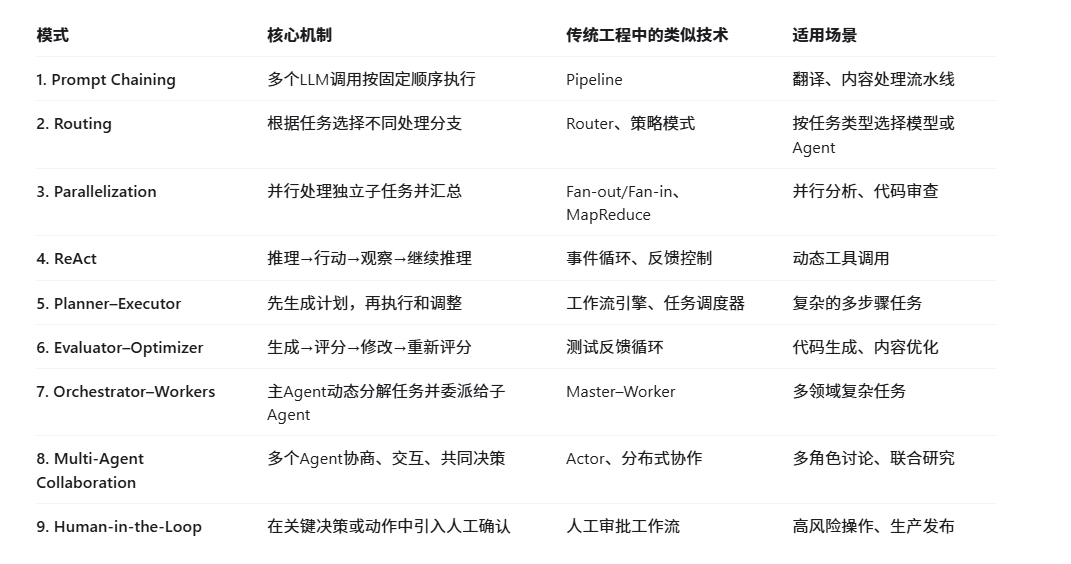
- Prompt Chaining
- Core Mechanisms
- Multiple LLM calls executed in a fixed order
- Analogies in Traditional Engineering
- Pipeline
- Use Cases
- Translation
- Content treatment of water currents
- Core Mechanisms
- Routing
- Core Mechanisms
- Selecting different processing branches according to mandate
- Analogies in Traditional Engineering
- Router
- Policy Mode
- Use Cases
- Select a model or Agent by task type
- Core Mechanisms
- Parallelization
- Core Mechanisms
- Separate sub-missions handled in parallel and aggregated
- Analogies in Traditional Engineering
- Fan-out/Fan-in
- MapReduce
- Use Cases
- Parallel analysis
- Code Review
- Core Mechanisms
- Planner–Executor
- Core Mechanisms
- Mr. Plan, implement and adjust.
- Analogies in Traditional Engineering
- Workstream engine
- Task Scheduler
- Use Cases
- Complex multi-step tasks
- Core Mechanisms
- Evaluator–Optimizer
- Core Mechanisms
- Generate → Rating → Modify → Rescoring
- Analogies in Traditional Engineering
- Test feedback loop
- Use Cases
- Code Generation
- Content Optimization
- Core Mechanisms
- Orchestrator–Workers
- Core Mechanisms
- Main Agent dynamic decomposition task assigned to Agent
- Analogies in Traditional Engineering
- Master–Worker
- Use Cases
- Complex multidisciplinary tasks
- Core Mechanisms
- Multi-Agent Collaboration
- Core Mechanisms
- Multi-Agent consultations, interaction, joint decision-making
- Analogies in Traditional Engineering
- Actor
- Distributive collaboration
- Use Cases
- Multi-role discussion
- Joint research
- Core Mechanisms
- Human-in-the-Loop
- Core Mechanisms
- Introduce manual confirmation in key decisions or actions
- Analogies in Traditional Engineering
- Manual approval of workflows
- Use Cases
- High-risk operations
- Production Publication
- Core Mechanisms
- Andrew NG
- ReAct
- Core Components
- Environment
- What It Is
- Intelligence is in the environment.
- Environmental feedback
- Observation
- Observations returned by environment or tool
- Observation
- What It Is
- Tools
- Classification
- Knowledge enhancement
- What It Is
- Retrieve External Information
- Search, SQL Query, Document Search
- What It Is
- Capacity development
- What It Is
- Bridging the lack of modelling capacity
- Calculator, Code Executor
- What It Is
- Writing Action
- What It Is
- Modify the external environment
- Modify files, send mail, update data Library
- What It Is
- Knowledge enhancement
- What It Is
- External capability interface for Agent
- How to Call
- Function Calling
- Process
- Modelled Tool Call
- Run-on-dol
- Return Tool Result
- Add the result to Context
- Process
- Function Calling
- Classification
- Planning
- What It Is
- Selection of actions based on objective, constraints and state of the environment
- Planning strategy
- Separation of planning and implementation
- Planned particle size
- Layer planning
- Rethinking and miscorrection
- Inspection plan
- Check implementation results
- Reprogramming as necessary
- What It Is
- Environment
- Harness
How to Optimize It
- Common Failure Modes
- Planning Failures
- Error selection tool, parameter error, target not completed
- Tool-Use Failures
- Error in tool execution, return error results, lack of necessary tools
- Efficiency and Cost Problems
- Too many steps, too long implementation time, too much cost High
- Planning Failures
Drag to pan, scroll to zoom, and click a node to expand or collapse it. Large maps start with deeper levels collapsed; click nodes to expand them.
Discussion
Sign in with GitHub to comment. Discussions are stored as GitHub Issues.View on GitHub