
NOTE
2.8 Red-Black Tree
Red-black tree properties, 2-3 trees, and implementation.
This is a historical learning note and may contain outdated or incomplete understanding.
1. What Is a Red-Black Tree
- A balanced binary search tree
- It satisfies the characteristics of a binary search tree: for any node, its key is greater than or equal to the key of the left child and less than or equal to the key of the right child
- The following five properties guarantee balance
- A node is either Red or Black
- The root node is Black
- Leaf nodes (external nodes and nil nodes) are Black
- The children of a Red node are Black
- Every path from any node to a leaf node contains the same number of Black nodes
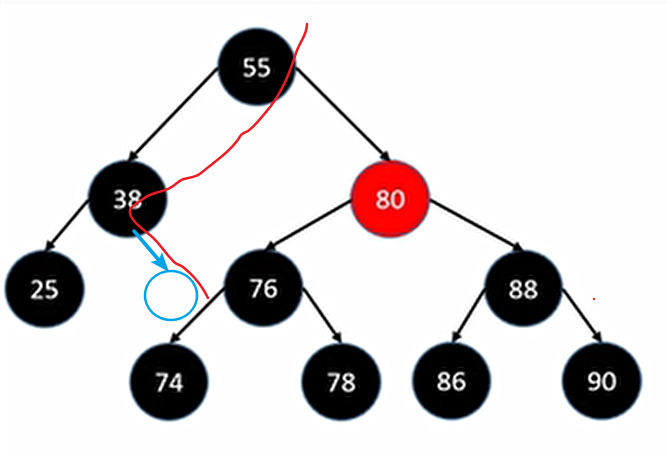 At first glance, the tree above seems to satisfy the five red-black tree properties. In fact, the path shown contains only two black nodes, so it is not a red-black tree.
1.1. Red-Black Tree vs Balanced Binary Tree
| Red-Black Tree | Balanced Binary Tree | |
|---|---|---|
| Binary search tree? | Yes | Yes |
| Balanced binary tree? | Weak balance (black balance) | Strong balance |
| Property | Five properties | Height difference between left and right subtrees does not exceed 1 |
| Efficiency | Faster insertion/deletion, slower lookup | Slower insertion/deletion, faster lookup |
2. 2-3 Tree
-
Satisfies the basic properties of a binary search tree
-
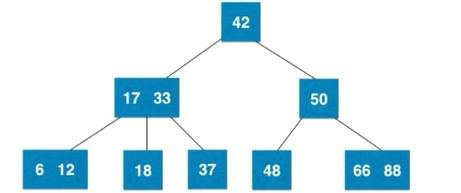
It is not a binary tree. It has two types of nodes: one type stores one element 【left child < a < right child】; the other stores two elements 【3 children, left child < b < middle child < c < right child】
-
-
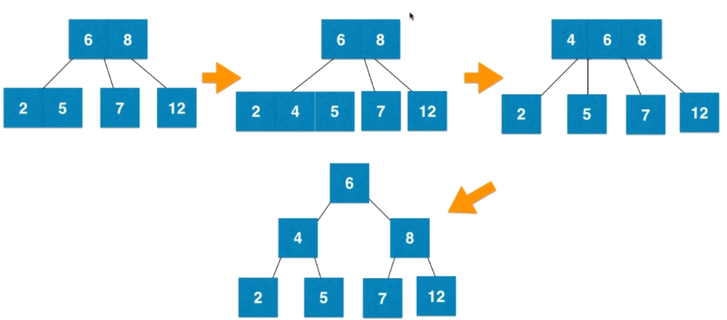
Insert into a 2-node
-
Insert into a 3-node

2.1. 2-3 Tree vs Heap vs Binary Search Tree
- A 2-3 tree is absolutely balanced
- The number of nodes passed from the root to any leaf is the same; for any node, the heights of the left and right subtrees are equal
- A heap is a complete binary tree, but not necessarily a full binary tree
- A binary search tree may degenerate into a linked list
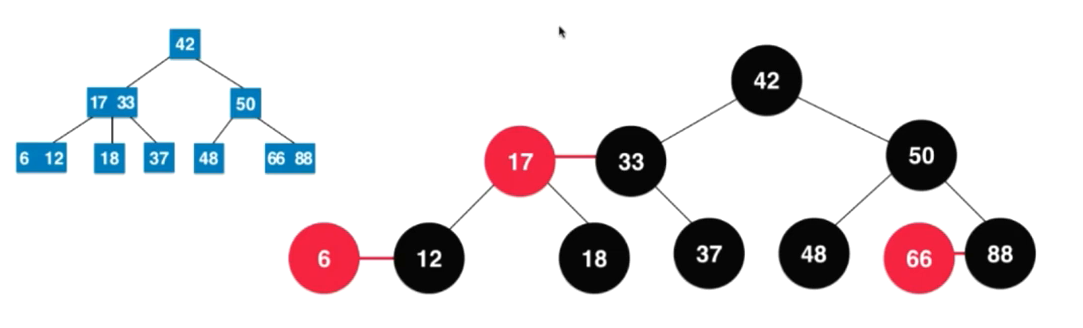
2.2. Equivalence Between 2-3 Tree and Red-Black Tree
3. Red-Black Tree
3.1. Data Structure
- Same as binary search tree
3.2. API
- Same as binary search tree
3.3. Implementation
const (
	// Red node
	Red = true
	// Black node
	Black = false
)

type node struct {
	data  model.Comparable
	left  *node
	right *node
	color bool
}

func (n *node) String() string {
	s := "Black"
	if IsRed(n) {
		s = "Red"
	}
	return fmt.Sprintf("%v-%v", n.data, s)
}

func newNode(value model.Comparable) *node {
	return &node{
		data: value,
		// New nodes are red by default because insertion first merges them into the existing structure
		color: Red,
	}
}

// Check the node color
func IsRed(n *node) bool {
	// Nil nodes are black
	if n == nil {
		return Black
	}
	return n.color
}

type RBTree struct {
	root   *node
	length int
}

func NewRBTree() *RBTree {
	return &RBTree{}
}

func (r *RBTree) String() string {
	s := fmt.Sprintf("length=%v, data={", r.Length())
	if r.root == nil {
		s += "}"
		return s
	}

	line := make([]*node, 0)
	allLines := make([][]*node, 0)

	queue := list.New()
	queue.PushBack(r.root)
	currentLineLast := r.root
	var nextLineLast *node
	for queue.Len() > 0 {
		n := queue.Remove(queue.Front()).(*node)
		line = append(line, n)
		if n.left != nil {
			queue.PushBack(n.left)
			nextLineLast = n.left
		}
		if n.right != nil {
			queue.PushBack(n.right)
			nextLineLast = n.right
		}
		if n == currentLineLast {
			currentLineLast = nextLineLast
			allLines = append(allLines, line)
			line = make([]*node, 0)
		}

	}

	for _, l := range allLines {
		s += fmt.Sprintf("%v\n", l)
	}
	s += "}"

	return s
}

func (r *RBTree) Length() int {
	return r.length
}

func (r *RBTree) IsEmpty() bool {
	return r.root == nil
}

//   node                     x
//  /   \     left rotate      /  \
// T1   x   --------->   node   T3
//     / \              /   \
//    T2 T3            T1   T2
func leftRotate(n *node) *node {
	x := n.right

	// Left rotation
	n.right = x.left
	x.left = n

	x.color = n.color
	n.color = Red
	return x
}

//     node                   x
//    /   \     right rotate     /  \
//   x    T2   ------->   y   node
//  / \                       /  \
// y  T1                     T1  T2
func rightRotate(n *node) *node {
	x := n.left

	// Right rotation
	n.left = x.right
	x.right = n

	x.color = n.color
	n.color = Red

	return x
}

func flipColors(n *node) {
	n.color = Red
	n.left.color = Black
	n.right.color = Black
}

func (r *RBTree) Add(data model.Comparable) {
	r.root = add(r.root, data)
	r.root.color = Black
	r.length++
}

func add(n *node, data model.Comparable) *node {
	if n == nil {
		return newNode(data)
	}
	if data.CompareTo(n.data) <= 0 {
		n.left = add(n.left, data)
	} else {
		n.right = add(n.right, data)
	}

	if IsRed(n.right) && !IsRed(n.left) {
		n = leftRotate(n)
	}
	if IsRed(n.left) && IsRed(n.left.left) {
		n = rightRotate(n)
	}
	if IsRed(n.left) && IsRed(n.right) {
		flipColors(n)
	}
	return n
}

func (r *RBTree) Contains(data model.Comparable) bool {
	return contains(r.root, data)
}

func contains(node *node, data model.Comparable) bool {
	if node == nil {
		return false
	}

	if data.CompareTo(node.data) < 0 {
		return contains(node.left, data)
	} else if data.CompareTo(node.data) > 0 {
		return contains(node.right, data)
	} else {
		return true
	}
}

func (r *RBTree) PreOrder() []*node {
	datas := make([]*node, 0)
	preOrder(r.root, &datas)
	return datas
}

func preOrder(node *node, datas *[]*node) {
	if node == nil {
		return
	}
	*datas = append(*datas, node)
	preOrder(node.left, datas)
	preOrder(node.right, datas)
}

func (r *RBTree) InOrder() []*node {
	datas := make([]*node, 0)
	inOrder(r.root, &datas)
	return datas
}

func inOrder(node *node, datas *[]*node) {
	if node == nil {
		return
	}
	inOrder(node.left, datas)
	*datas = append(*datas, node)
	inOrder(node.right, datas)
}

func (r *RBTree) PostOrder() []*node {
	datas := make([]*node, 0)
	postOrder(r.root, &datas)
	return datas
}

func postOrder(node *node, datas *[]*node) {
	if node == nil {
		return
	}
	postOrder(node.left, datas)
	postOrder(node.right, datas)
	*datas = append(*datas, node)
}

func (r *RBTree) LevelOrder() []*node {
	datas := make([]*node, 0)
	levelOrder(r.root, &datas)
	return datas
}

func levelOrder(n *node, datas *[]*node) {
	if n == nil {
		return
	}
	queue := list.New()
	queue.PushBack(n)
	for queue.Len() > 0 {
		e := queue.Remove(queue.Front()).(*node)
		*datas = append(*datas, e)
		if e.left != nil {
			queue.PushBack(e.left)
		}
		if e.right != nil {
			queue.PushBack(e.right)
		}
	}
}

// Note: Remove / RemoveMin / RemoveMax below use ordinary BST deletion logic and do not maintain red-black tree properties.
func (r *RBTree) Remove(data model.Comparable) {
	if r.root == nil {
		return
	}
	r.root = r.remove(r.root, data)
}

func (r *RBTree) remove(n *node, data model.Comparable) *node {
	if n == nil {
		return nil
	}
	// Find the node to delete
	if data.CompareTo(n.data) < 0 {
		n.left = r.remove(n.left, data)
		return n
	} else if data.CompareTo(n.data) > 0 {
		n.right = r.remove(n.right, data)
		return n
	} else {
		// Perform the deletion
		r.length--
		return doRemove(n)
	}
}

func doRemove(n *node) *node {
	// The left subtree is empty
	// Delete the current node and move the right subtree up as the root
	// Similar to removeMin
	if n.left == nil {
		rightNode := n.right
		n.right = nil
		return rightNode
	}
	// The right subtree is empty
	// Delete the current node and move the left subtree up as the root
	// Similar to removeMax
	if n.right == nil {
		leftNode := n.left
		n.left = nil
		return leftNode
	}

	// Both the left and right subtrees are non-empty
	// First find the successor of the current node, i.e. the minimum node in the right subtree, to replace this node
	successor := min(n.right)
	successor.right = removeMin(n.right)
	successor.left = n.left
	// Delete the current node
	n.left = nil
	n.right = nil
	return successor
}

func (r *RBTree) Max() *node {
	if r.root == nil {
		return nil
	}
	return max(r.root)
}

func max(n *node) *node {
	if n.right == nil {
		return n
	}
	return max(n.right)
}

func (r *RBTree) Min() *node {
	if r.root == nil {
		return nil
	}
	return min(r.root)
}

func min(n *node) *node {
	if n.left == nil {
		return n
	}
	return min(n.left)
}

func (r *RBTree) RemoveMax() *node {
	if r.root == nil {
		return nil
	}
	e := r.Max()
	r.root = removeMax(r.root)
	r.length--
	return e
}

func removeMax(n *node) *node {
	if n == nil {
		return nil
	}
	// If the right subtree is empty, the current node is the maximum node
	// Delete the current node and move the left subtree up as the root
	if n.right == nil {
		leftNode := n.left
		n.left = nil
		return leftNode
	}
	n.right = removeMax(n.right)
	return n
}

func (r *RBTree) RemoveMin() *node {
	if r.root == nil {
		return nil
	}
	e := r.Min()
	r.root = removeMin(r.root)
	r.length--
	return e
}

func removeMin(n *node) *node {
	if n == nil {
		return nil
	}
	// If the left subtree is empty, the current node is the minimum node
	// Delete the current node and move the right subtree up as the root
	if n.left == nil {
		rightNode := n.right
		n.right = nil
		return rightNode
	}
	n.left = removeMin(n.left)
	return n
}
3.3.1. Test
func TestRBTree(t *testing.T) {
	rbTree := NewRBTree()

	e1 := model.NewElement(1)
	e2 := model.NewElement(2)
	e3 := model.NewElement(3)
	e4 := model.NewElement(4)
	e5 := model.NewElement(5)

	rbTree.Add(e3)
	rbTree.Add(e2)
	rbTree.Add(e4)
	rbTree.Add(e1)
	rbTree.Add(e5)

	fmt.Println("Initial data: ", rbTree)
	fmt.Println("Level-order traversal: ", rbTree.LevelOrder())
	fmt.Println("Preorder traversal: ", rbTree.PreOrder())
	fmt.Println("Inorder traversal: ", rbTree.InOrder())
	fmt.Println("Postorder traversal: ", rbTree.PostOrder())

	fmt.Println("Minimum node: ", rbTree.Min())
	fmt.Println("Maximum node: ", rbTree.Max())
	fmt.Println("Delete minimum node: ", rbTree.RemoveMin())
	fmt.Println("After deleting the minimum node: ", rbTree)
	rbTree.Remove(e3)
	fmt.Println("After deleting the root node: ", rbTree)

}
Discussion
Sign in with GitHub to comment. Discussions are stored as GitHub Issues.View on GitHub