
NOTE
2.2 Distributed Transaction Solution: TCC
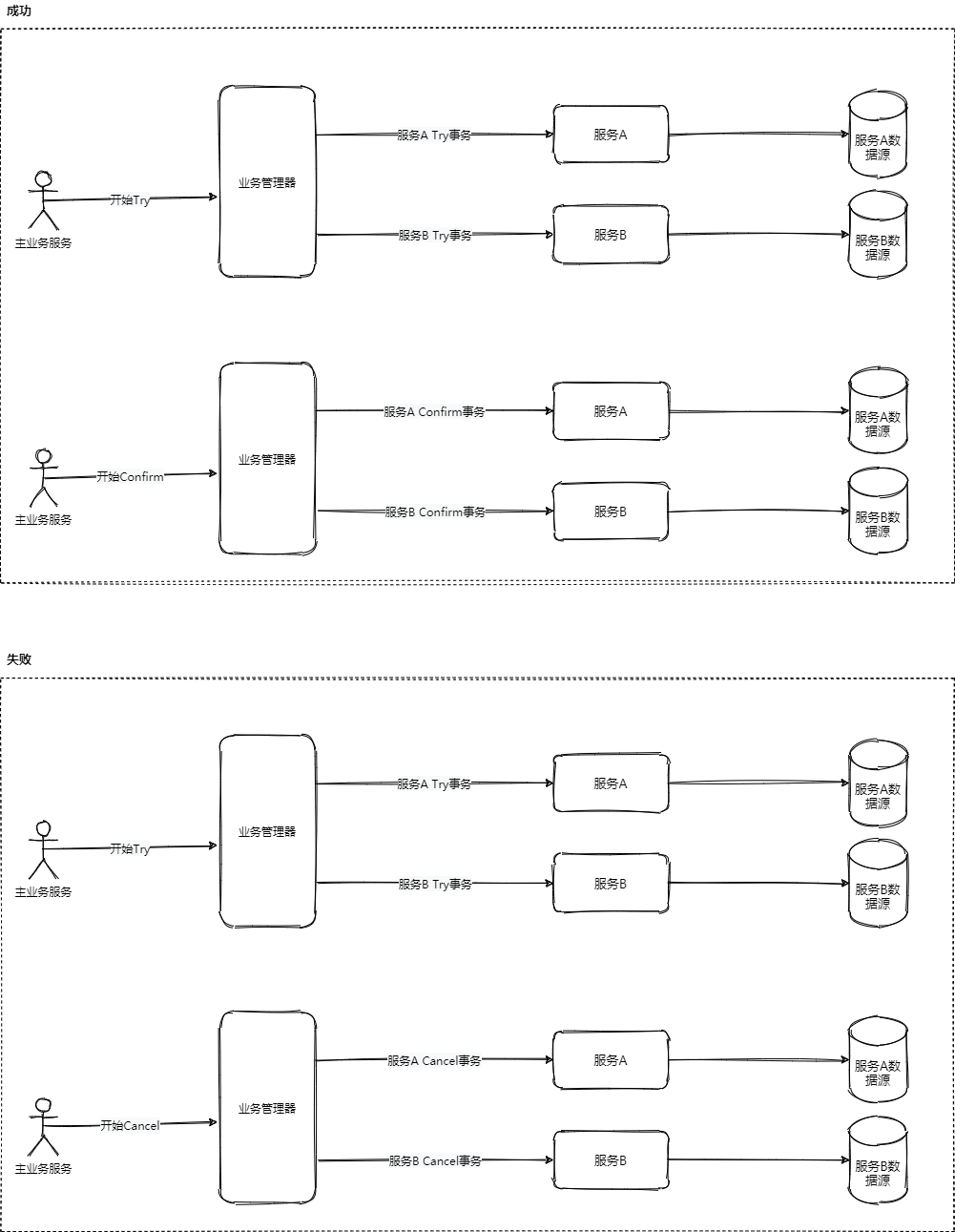
1. What Is TCC - A distributed transaction solution that guarantees eventual consistency. 2. TCC Process - TCC: Try, Confirm, Cancel. - Divide the transaction into two phases. - In Phase 1, execute Try to perform business checks and reserve resources. - Phase 2 depends on the result of Phase 1.
This is a historical learning note and may contain outdated or incomplete understanding.
1. What Is TCC?
A distributed transaction solution that guarantees eventual consistency.
2. TCC Process
- TCC: Try, Confirm, Cancel.
- Divide the transaction into two phases:
- In Phase 1, execute Try to perform business checks and reserve resources.
- Phase 2 depends on the result of Phase 1.
- If Phase 1 succeeds, execute Confirm to perform business confirmation.
- If Phase 1 fails, execute Cancel (perform an operation opposite to Try, similar to a manual rollback).
3. 2PC vs TCC
- It is very similar to 2PC; both have two phases.
- 2PC is a two-phase approach at the database layer, while TCC is a two-phase approach at the application layer.
- Each Try, Confirm, and Cancel in TCC runs in a separate transaction, while 2PC operates within one transaction.
- TCC solves several shortcomings of 2PC:
- Performance problem: Phase 1 only checks and reserves resources; it does not need to lock them until Phase 2.
- Single-point problem: after Phase 1 is complete, if the business activity manager goes down in Phase 2, there are still other business activity managers.
- Consistency problem: after Phase 1 is complete, if any participant goes down in Phase 2 and does not return an ACK, keep retrying until it succeeds (because Phase 1 has already reserved the resources and can guarantee success).
4. Problems with TCC
- Highly intrusive: depends on the business side to cooperate by providing Try, Confirm, and Cancel interfaces.
5. Use Cases for TCC
- Suitable for business results that require strong consistency, high real-time performance, and whose distributed transactions can be rolled back, such as the three core services in Internet finance companies: trading, payments, and accounting.
- Multiple services use multiple data sources, and the data sources do not have to be DBs.
6. Implementations of TCC
6.1. Seata TCC Mode
- Does not depend on transaction support from the underlying data resources:
- Phase-one prepare behavior: call custom prepare logic.
- Phase-two commit behavior: call custom commit logic.
- Phase-two rollback behavior: call custom rollback logic.
6.2. Seata AT Mode
- Based on relational databases that support local ACID transactions.
- Java applications access the database through JDBC.
- In Seata’s AT mode, we do not need to write Phase 2 at all; it is entirely implemented by Seata itself.
Discussion
Sign in with GitHub to comment. Discussions are stored as GitHub Issues.View on GitHub