
NOTE
3.5 Recursion
Recursion, its call process, basic ideas, examples, conversion to iteration, and tail recursion.
This is a historical learning note and may contain outdated or incomplete understanding.
1. What Is Recursion
- A function calls itself
2. The Recursion Call Process
- Take a sum function as an example
package recursion

func Sum(data ...int) int {
	return sum(data, 0, len(data)-1)
}

func sum(data []int, left int, right int) int {
	if left == right {
		return data[left]
	}

	return data[left] + sum(data, left+1, right)
}- Test
import (
	"fmt"
	"testing"
)

func TestSum(t *testing.T) {
	fmt.Println(Sum(1, 2, 3, 4))
}- Process analysis
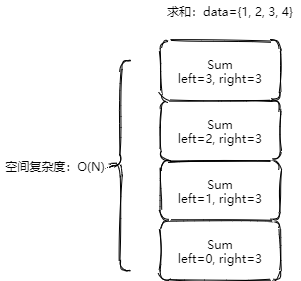
3. Basic Idea of Recursion
- Break down the problem
- Break a large problem into smaller problems
- Break smaller problems into even smaller problems
- When the problem is small enough, the answer can be obtained directly
- Solve
- Use the solution of the smallest problem to obtain the solution of a larger problem
- Use the solution of the larger problem to obtain the solution of an even larger problem
- Finally obtain the solution to the original problem
4. Recursion Template
- Function purpose
- Do not first think about how to write the code; think about what the function does and what function it completes
- Clarify the relationship between the original problem and the subproblem
- The relationship between
f(n)andf(n-1)
- The relationship between
- Clarify the recursion base case
- The solution of
f(1)
- The solution of
5. Examples
5.1. Tower of Hanoi
func Hanoi() {
	hanoi(4, "A", "B", "C")
}

func hanoi(n int, p1 string, p2 string, p3 string) {
	if n <= 1 {
		move(n, p1, p3)
		return
	}
	// Move n - 1 disks from p1 to p2 with the help of p3
	hanoi(n-1, p1, p3, p2)
	// Move disk n from p1 to p3
	move(n, p1, p3)
	// Move n - 1 disks from p2 to p3 with the help of p1
	hanoi(n-1, p2, p1, p3)
}

func move(n int, from string, to string) {
	fmt.Println(fmt.Sprintf("disk %v: %v->%v", n, from, to))
}
5.2. Fibonacci
5.3. Climbing Stairs
5.4. Variant of Climbing Stairs
6. Converting Recursion to Non-Recursion
- Method 1: maintain a stack to save parameters and local variables
type Frame struct {
	data  []int
	left  int
	right int
}

func NewFrame(data []int, left int, right int) *Frame {
	return &Frame{data: data, left: left, right: right}
}

func Sum2(data ...int) int {
	stack := make([]*Frame, 0)
	for i := 0; i < len(data); i++ {
		stack = append(stack, NewFrame(data, i, len(data)-1))
	}

	sum := 0
	for len(stack) > 0 {
		top := stack[len(stack)-1]
		stack = stack[:len(stack)-1]
		sum += top.data[top.left]
	}

	return sum

}- Method 2: loop
func Sum3(data ...int) int {
	sum := 0
	for _, datum := range data {
		sum += datum
	}

	return sum
}
7. Tail Recursion
7.1. What It Is
- Tail call: the last action of a function is to call a function
- Tail recursion: the last action of a function is to call itself
7.1.1. Example
func test1() {
	a := 10
	b := a + 20
	test2(b)
}

func test2(n int) {
	if n < 0 {
		return
	}
	test2(n - 1)
}
7.2. Tail Call Optimization
- The compiler can optimize tail calls to save stack space
- Reuse test1’s stack frame for test2, then jump to test2’s function code
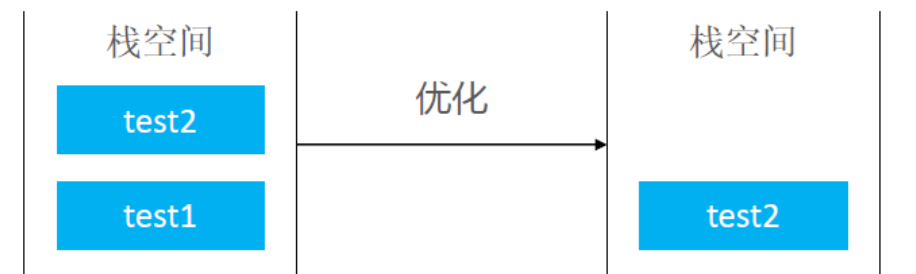
8. Why Only Tail Calls Can Be Optimized
func test3() {
	a := 10
	b := 20
	test4(b)
	// Normally this should print 30
	// With tail-call optimization here, a would be overwritten by x and b by y, so the result would be 70, which is incorrect
	fmt.Println(a + b)
}

func test4(n int) {
	x := 30
	y := 40
	fmt.Println(x + y) //70
}
Discussion
Sign in with GitHub to comment. Discussions are stored as GitHub Issues.View on GitHub