
NOTE
1.7 MySQL Locks
1. What Is a Lock - Database Locks.md 2. Lock Implementation - trx information: indicates which transaction generated this lock structure - is_waiting: indicates whether the current transaction is waiting 3. Lock Classification - Based on locking scope, MySQL locks can roughly be divided into global locks, table-level locks, and row locks 3.1. Global Lock 3.1.1. What It Is - Flush tables with read lock locks the entire database instance
This is a historical learning note and may contain outdated or incomplete understanding.
1. What Is a Lock
2. Lock Implementation
trxinformation: indicates which transaction generated this lock structure.is_waiting: indicates whether the current transaction is waiting.
3. Lock Classification
- Based on locking scope, MySQL locks can roughly be divided into three categories: global locks, table-level locks, and row locks.
3.1. Global Lock
3.1.1. What It Is
Flush tables with read locklocks the entire database instance.- The entire database becomes read-only. Other threads are blocked when executing the following statements: data update statements (insert/delete/update), data definition statements (including creating tables and changing table structures), and commit statements for update transactions.
3.1.2. Why It Is Needed
- Full-database logical backup.
3.1.2.1. MVCC RR vs Global Lock
- RR can obtain a consistent view, so a global lock is actually unnecessary in that case, but RR is specific to the InnoDB storage engine.
3.2. Table-Level Locks
3.2.1. Table Locks
3.2.1.1. What They Are
- If thread A executes
lock tables t1 read, t2 write, then thread A can readt1, read and writet2, but cannot writet1; at the same time, other threads cannot writet1or read/writet2.
3.2.1.2. Why They Are Needed
- Before finer-grained locks appeared, table locks were the most commonly used way to handle concurrency.
3.2.2. Metadata Locks
3.2.2.1. What They Are
- When performing insert/delete/update/query operations on a table, an MDL read lock is added; when changing the table structure, an MDL write lock is added.
3.2.2.2. Why They Are Needed
- For example, if the table structure changes while data is being queried, the data would become incorrect.
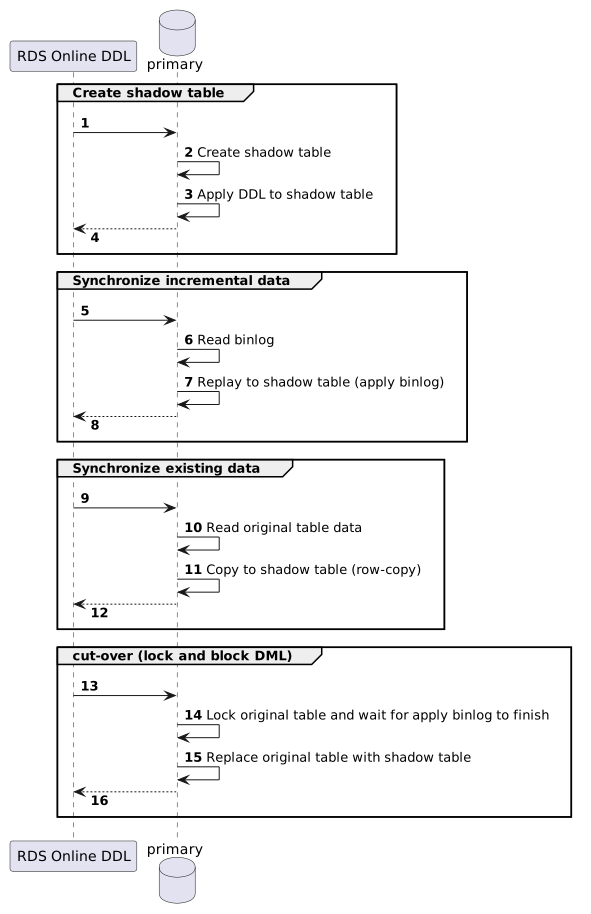
3.2.2.3. Online DDL
- To avoid deadlock, add
WAITwhen changing the table structure.
ALTER TABLE tbl_name NOWAIT add column ...
ALTER TABLE tbl_name WAIT N add column ...
Does MySQL ALTER TABLE Lock the Table When Adding a Column? - Juejin A MySQL DDL Caused a Table Lock - CSDN
- Internal document: MySQL Online DDL (anonymized)
- Internal document: MySQL Online DDL Details (anonymized) MySQL Tool gh-ost Principle Analysis - MoTianLun Six Methods for Batch Updating Data in MySQL - Juejin GitHub - github/gh-ost: GitHub’s Online Schema-migration Tool for MySQL
3.2.2.3.1. gh-ost
4. MyISAM
- Supports only table-level locks.
- Because it does not support transactions, locks are session-level.
- If session A performs a
select, it needs a table-level S lock. At this time, if session B performs anupdate, it needs a table-level X lock. Since another session already holds an S lock, it can only block.
- If session A performs a
4.1. Write-Lock Experiment
- session1
# Add write lock
lock table mylock write;
# Can query the locked table
select * from mylock;

# Cannot query other tables
select * from ttest;

# Can modify the locked table
update mylock set name = '111' where id = 1;

unlock tables ;- session2
# Querying the table write-locked by session1 blocks
select * from mylock;

# Can query other tables
select * from ttest;

# Modifying the table write-locked by session1 blocks
update mylock set name = '222' where id = 1;
4.2. Read-Lock Experiment
- session1
# Add read lock
lock table mylock read;
# Can query the locked table
select * from mylock;
# Cannot change a table with a read lock
update mylock set name = 'qqq' where id = 1;
# Cannot query other tables
select * from ttest;
# session2's write can continue only after unlocking
unlock tables ;- session2
# Can query a table locked by another session
select * from mylock;
# Modification blocks
update mylock set name = 'qqq' where id = 1;
# Can query other tables
select * from ttest;
5. InnoDB
- Supports table-level locks and row-level locks.
- Because it supports transactions, locks are transaction-level.
- Table-level S and X locks are not very useful here.
- When transaction A executes DDL and transaction B executes DML, B is blocked. This uses metadata locks rather than table-level locks.
- Table-level IS and IX locks are similarly not very useful by themselves.
- IS and IX exist to serve table-level S and X locks. Since the S and X table locks above are of limited practical use here, the derived IS and IX locks are also of limited practical use by themselves.
- Table-level AUTO-INC lock:
- used for auto-increment columns.
- Row locks:
- Record Locks:
- Locks on a single row record.
- Divided into S locks and X locks.
- If transaction A adds an S lock to a record, transaction B can continue to add an S lock, but cannot add an X lock.
- If transaction A adds an X lock to a record, transaction B can add neither an S lock nor an X lock.
- Gap Locks:
- Gap locks lock a range but do not include the record itself.
- MySQL solves the phantom-read problem under the Repeatable Read level through Gap Locks.
- For example, if the existing primary-key range is
[1,20], adding a Gap Lock to the Supremum record means records cannot be inserted before the Supremum record (not including the Supremum record), that is, in[21,+∞). - Gap Locks are used to prevent phantom-related inserts and do not conflict with other gap locks.
- Next-Key Locks:
- record + gap: lock a range including the record itself.
- When you want to lock a record and also prevent other transactions from inserting a new record into the gap before it, that is, lock
[A,B]. - Gap Locks + Record Locks.
- Record Locks:
5.1. Row-Lock Experiment
- session1
# First disable autocommit
# Query
select * from ttest;
# Update the row with id=1; a row lock will be added
update ttest set status = 'never' where id = 1;
# Query again and it is already updated
select * from ttest;- session2
# session1 has already updated it, but it is not visible here because of the transaction isolation level
select * from ttest;
# If I try to update the same row as session1, it blocks. This is a row lock
update ttest set status = 'never' where id = 1;
5.2. Index Invalidation Causing Many Records to Be Locked
If a varchar indexed column is compared after implicit type conversion, the index may become unusable. InnoDB may then scan and lock many records or ranges; this is not a generic row-lock-to-table-lock escalation.
- session1
# title has an index and is varchar, but the WHERE value is accidentally written as an integer, which may make the index unusable and lock many records/ranges
update tb_item set title = 'zzzzz', sell_point = 'zzz' where title = 121;
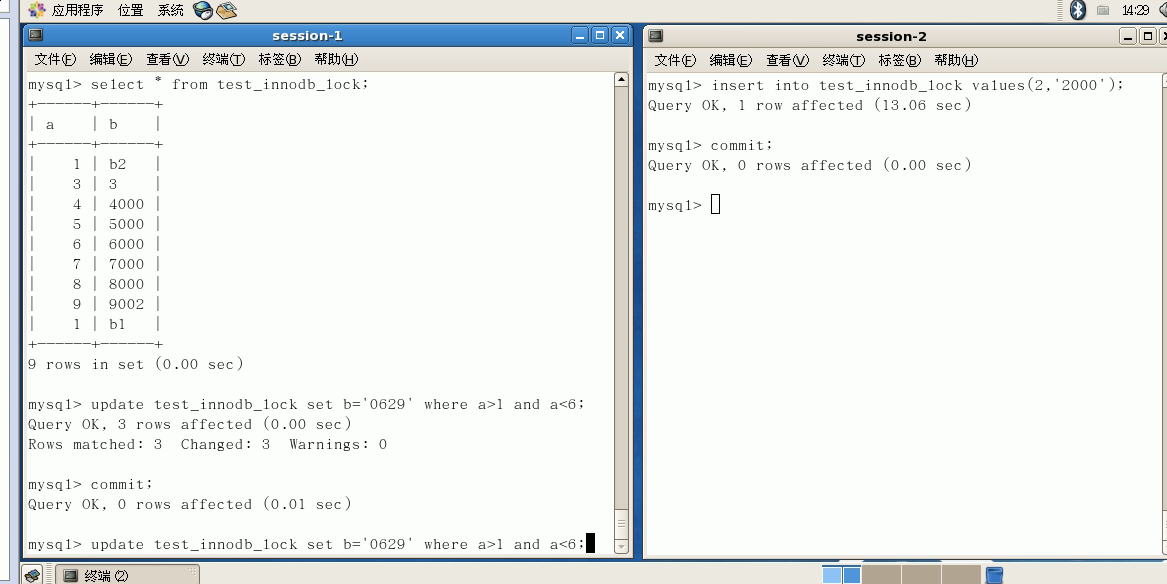
5.3. Gap-Lock Experiment
A gap lock: IDs are not contiguous. One transaction updates and locks according to a range, for example 1<=id<=6; another transaction inserts data that happens to be within this range, for example id=2, so it blocks.
5.4. Full-Table Update
An UPDATE Without an Index Locks the Whole Table! - Huawei Cloud Does a MySQL UPDATE Lock Rows or the Table? - CSDN
Discussion
Sign in with GitHub to comment. Discussions are stored as GitHub Issues.View on GitHub