
NOTE
1.17 Cloud Elasticsearch
English translation of the original VNote ‘Cloud Elasticsearch’, preserving its Tencent Cloud notes, structure, and references.
This is a historical learning note and may contain outdated or incomplete understanding.
1. Tencent Cloud Elasticsearch
Based on VIP + the native Elasticsearch suite.
- VIP: provides addressing + load balancing + health checking, similar to the Polaris service registry. This VIP is bound to all data nodes inside the cluster and provides load balancing. All user requests are distributed evenly across the cluster’s data nodes. The VIP also includes health checking. If repeated checks within a period confirm that a node is not responding, the health-check mechanism temporarily removes the problematic node from the VIP binding list until the node returns to normal.
- Elasticsearch suite: integrates Elasticsearch, Kibana, and X-Pack; version 7.10.1; master and data nodes can be the same node. When the node count exceeds a certain number, separate master nodes can also be created. Each node has a 100 GB disk, 2 CPU cores, and 4 GB memory.
1.1. Deployment
1.1.1. Single Availability Zone in the Same Region
Master nodes and data nodes are in the same availability zone, and the primary and replica shards of data nodes are also in the same availability zone.
1.1.2. Multiple Availability Zones in the Same Region
Assume deployment across two availability zones. The number of data nodes is specified when applying and must be a multiple of the number of availability zones. Master nodes are deployed across three availability zones.
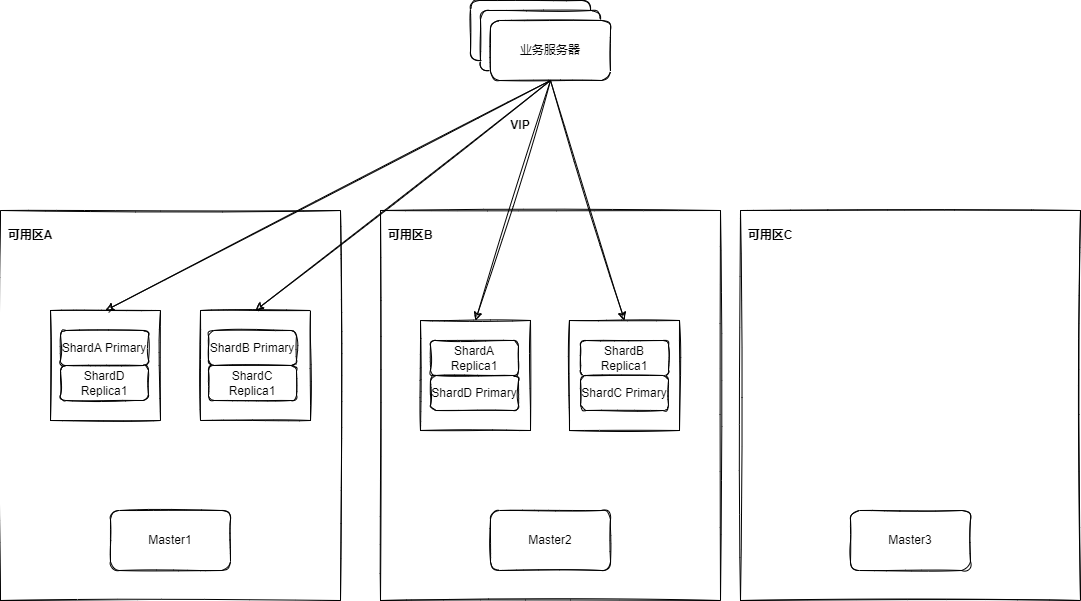
1.1.2.1. Problems
- A single availability zone becomes unavailable. Same as Cloud Redis.
- Network-partition problem: if availability zones A and B become network-isolated, will they become two clusters? Because ES uses a majority mechanism, split brain will not occur.
1.1.3. Hot-Cold Separation
Elasticsearch is mainly used to store and retrieve massive amounts of data. If all data is placed on SSDs, the cost is very high. Hot-cold separation can solve this problem. A hot-cold cluster can contain both hot and cold nodes in one cluster, balancing the conflict between performance and capacity:
- Hot data with relatively high read/write performance requirements (for example, logs from the last 7 days) can be stored on SSD disks on hot nodes.
- Indices with large storage requirements but lower read/write performance requirements (for example, logs from one month or even longer) can be stored on SATA disks on cold nodes.
1.1.4. Dedicated Master Nodes
Three are recommended.
1.2. Availability
1.2.1. SLA
The service availability of this service is no lower than 99.9%.
1.3. Consistency
1.3.1. Latency
Within the same region, generally within 5 ms.
1.4. Capacity
Elasticsearch Service 集群规格和容量配置评估-快速入门-文档中心-腾讯云
1.5. Scalability
1.6. Cost
Elasticsearch Service 计费概述-购买指南-文档中心-腾讯云
1.7. Parameters
1.8. Monitoring
2. References
- Elasticsearch Service YML 文件配置-Elasticsearch 指南-文档中心-腾讯云-腾讯云
- Elasticsearch Service 集群多可用区部署-操作指南-文档中心-腾讯云-腾讯云
- 服务等级协议
- Elasticsearch Service 计费概述-购买指南-文档中心-腾讯云
- Elasticsearch Service 服务等级协议-文档中心-腾讯云
- Elasticsearch Service 创建集群-快速入门-文档中心-腾讯云
- Elasticsearch Service 查看监控-Elasticsearch 指南-文档中心-腾讯云
- Elasticsearch Service 冷热分离与索引生命周期管理-最佳实践-文档中心-腾讯云
- Elasticsearch Service 相关概念-产品简介-文档中心-腾讯云
Discussion
Sign in with GitHub to comment. Discussions are stored as GitHub Issues.View on GitHub