
NOTE
2.3 Redis Data Structures
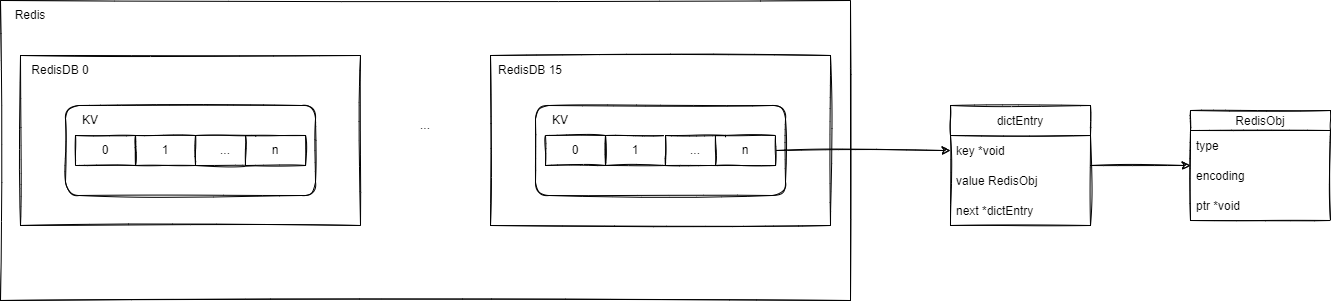
1. Redis DB - redisDb is the data structure used by Redis to represent a DB and contains a dict; dict is the K-V data structure in Redis and contains dictht; dictht is an array whose elements are dictEntry nodes; dictEntry.next uses chaining to resolve hash collisions
This is a historical learning note and may contain outdated or incomplete understanding.
1. Redis DB
redisDb is the data structure used by Redis to represent a DB, and it contains a dict type.
dict is the data structure used by Redis to represent K-V pairs, and it contains a dictht type.
dictht is an array, and each element in the array is a dictEntry. (That is, Redis uses a hash structure to implement K-V.)
The next pointer of dictEntry indicates that chaining is used to resolve hash collisions.
The val pointer of dictEntry points to a redisObject. (That is, the five Redis data structures.)
The type of redisObject indicates the five data structures, and encoding indicates the underlying encoding type of that data structure.
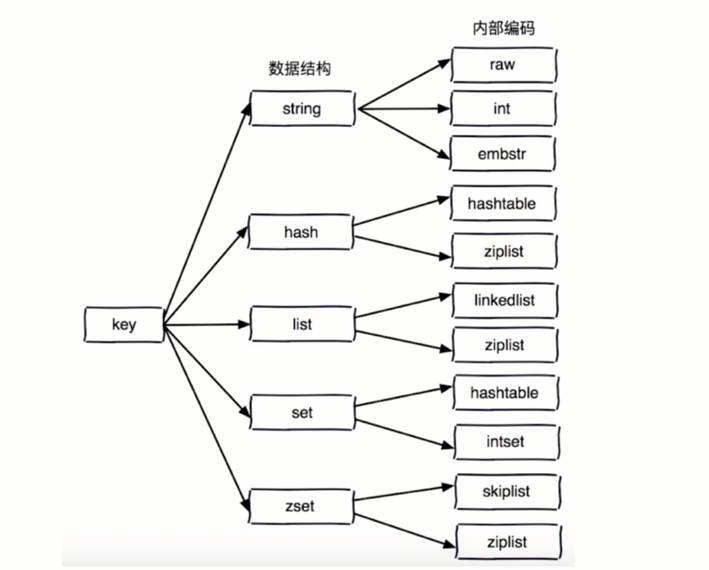
Redis keys are all string types. Values have five types, and each value type corresponds to multiple internal encodings.
2. string
- String.
- Up to 512 MB.
2.1. Use Cases
- Cache: How to Design a Cache System
- Distributed lock: Redis Distributed Locks
- Counter.
- Web-cluster session.
- Global sequence number in a distributed system.
2.2. Underlying Implementation
- The underlying implementation is a string. Redis strings do not end with
\0like C strings. Instead, Redis defines a data structure calledsdshdr.lenindicates the length of the string.freeindicates how much free space remains.bufstores the string.
- If the stored string is only one byte, much of the space is wasted on metadata (
lenandfree), so multiple structures were introduced after Redis 3.2. - If the value is an int, the underlying implementation is an int.
127.0.0.1:6379> set k1 v1
OK
127.0.0.1:6379> object encoding k1
"embstr"
127.0.0.1:6379> set k2 1
OK
127.0.0.1:6379> object encoding k2
"int"
127.0.0.1:6379> set k3 some_value
OK
127.0.0.1:6379> object encoding k3
"embstr"
127.0.0.1:6379> set k5 ssssssssssssssssssssssssssssssssssssssssssssssss
OK
127.0.0.1:6379> object encoding k5
"raw"
3. list
An ordered collection that allows duplicates.
3.1. Use Cases
- Asynchronous queue: Redis Asynchronous Queue
- Weibo follower list.
3.2. Underlying Implementation
- When the amount of data is relatively small, it is implemented with a ziplist:
ziplist.md(the related note has not been published yet).- Each item stored in the list (possibly a string) is smaller than 64 bytes.
- The list contains fewer than 512 items.
- When the amount of data is relatively large, it is implemented with a doubly circular linked list:
linkedlist.md(the related note has not been published yet).
4. set
An unordered collection with no duplicates.
4.1. Use Cases
- Implement idempotency: prevent duplicate form submissions and implement message-queue idempotency.
- Likes, favorites, tags.
- Following relationships.
- When sending email, if there are English users then send in English; store the English users’ email addresses in a set.
4.2. Underlying Implementation
- When both of the following conditions are met, an ordered array is used:
array.md(the related note has not been published yet).- All stored data is integer data.
- The number of stored elements does not exceed 512.
- Otherwise a hashmap is used:
hashmap.md(the related note has not been published yet).
5. zset / sorted set
A set with sorting functionality.
5.1. Use Cases
- Leaderboards.
5.2. Underlying Implementation
- When the amount of data is relatively small, it is implemented with a ziplist:
ziplist.md(the related note has not been published yet).- Fewer than 128 elements.
- Each element is shorter than 64 bytes.
- When the amount of data is relatively large, it is implemented with a skiplist:
Skip List.md(the related note has not been published yet).- Because of the skiplist, an element can be inserted in
O(logN)time, and elements can be found quickly by score range.
- Because of the skiplist, an element can be inserted in
- Looking up a score by member (
zscore) is implemented using a hash.
6. hash
K-V pairs.
6.1. Use Cases
hmsetfor fine-grained caching.hmset+ Lua script to implement a token-bucket rate-limiting algorithm: Redis RateLimiter
6.2. Underlying Implementation
- When the amount of data is relatively small, it is implemented with a ziplist:
ziplist.md(the related note has not been published yet).- Both keys and values stored in the dictionary are smaller than 64 bytes.
- The dictionary contains fewer than 512 key-value pairs.
- When the amount of data is relatively small, it is implemented with a hashmap:
hashmap.md(the related note has not been published yet).
7. Other Structures
7.1. BitMap
7.1.1. Use Cases
8. References
- 深入了解Redis底层数据结构 - 掘金
- 通俗易懂的Redis数据结构基础教程 - 掘金
- 【金三银四】Redis面试热点之底层实现篇 - 掘金
- 9.1.1 The ziplist representation | Redis Labs
- redis zset内部实现 | Hello Coder
- Redis zset实现原理 - 掘金
- Redis 命令参考 — Redis 命令参考
- redis zset内部实现 | Hello Coder
- Command reference – Redis
- An introduction to Redis data types and abstractions – Redis
- redis zscore时间复杂度_Redis有序集合底层实现及命令复杂度_橙欲闻的博客-CSDN博客
Discussion
Sign in with GitHub to comment. Discussions are stored as GitHub Issues.View on GitHub