
NOTE
1.2 TCP Four-Way Handshake
What the TCP four-way connection termination is, how it works, why four handshakes are needed, and TIME_WAIT/CLOSE_WAIT states.
This is a historical learning note and may contain outdated or incomplete understanding.
1. What Is the Four-Way Handshake?
The so-called four-way handshake means that four packets need to be sent when TCP disconnects.
2. Four-Way Handshake Process
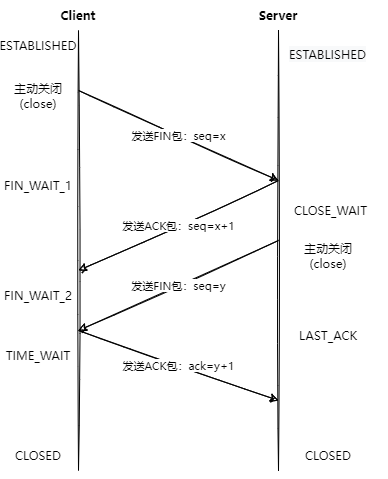
At the beginning, both the client and server are in the ESTABLISHED state. Assume that the client starts closing the connection.
Memory aid: set FIN/ACK to 1. FIN comes with a SEQ Number, and ACK comes with an ACK Number. After sending, consider which state is entered.
- First handshake
The client sends a segment.
Set FIN to 1 and SEQ Number to X.
After sending, the client enters the FIN_WAIT_1 state.
- Second handshake
The server replies with a segment.
Set ACK to 1 and ACK Number to x+1.
After the server sends it, it enters the CLOSE_WAIT state.
After the client receives this acknowledgement packet, it enters the FIN_WAIT_2 state.
- Third handshake
The server sends a segment.
Set FIN to 1 and SEQ Number to Y.
After sending, the server enters the LAST_ACK state.
- Fourth handshake
The client replies with a segment.
Set ACK to 1 and ACK Number to Y+1.
After sending, the client enters the TIME_WAIT state and waits for possible requests to retransmit the ACK packet.
After the server receives this acknowledgement packet, it enters the CLOSED state.
After the client waits for a fixed period of time (2MSL), it enters the CLOSED state.
3. Why Are Four Handshakes Needed?
The first two handshakes disconnect the client’s data-sending channel. After it is disconnected, the server can still send messages to the client.
The last two handshakes disconnect the server’s data-sending channel.
Discussion
Sign in with GitHub to comment. Discussions are stored as GitHub Issues.View on GitHub