
NOTE
Fund Classification
English translation of the original VNote “Fund Classification”, preserving its structure with only necessary small corrections.
This is a historical learning note and may contain outdated or incomplete understanding.
1.1. Classification Criteria
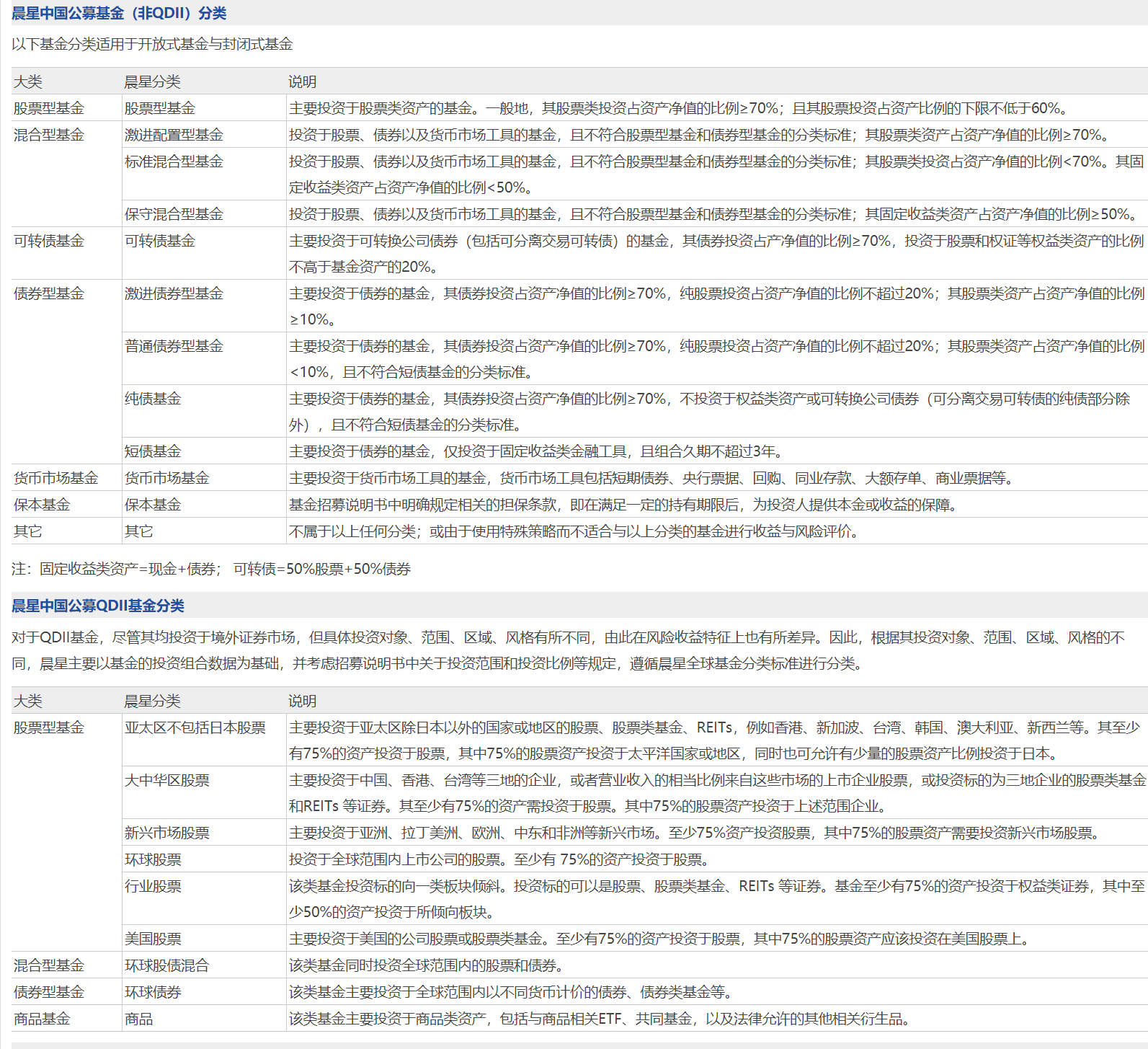
- According to whether fund units can be added or redeemed: open-ended funds and closed-end funds.
- According to investment targets: equity funds, mixed funds, bond funds, and money-market funds.
- According to investment style: growth, value, and balanced.
- According to investment region: domestic, QDII, and Hong Kong mutual-recognition funds.
- According to management style: passive and active.
- According to whether they are bought directly from the fund company: off-exchange funds and exchange-traded funds.
1.2. Classification by Investment Style
- Compare a fund’s daily rise and fall with the CSI 300 Index, ChiNext Index, and SME Board Index to roughly determine the fund’s style and the style of its current portfolio. If the fund’s performance is closer to the ChiNext Index or SME Board Index, its style may lean more toward growth.
- If the fund’s performance is closer to the CSI 300 Index, its style may lean more toward value. In practice, choose trading days when the CSI 300, ChiNext, and SME Board indexes diverge sharply for comparison.
1.2.1. Growth Funds
- Generally refers to funds that mainly invest in growth stocks.
- Growth stocks refer to companies that are still in a high-growth stage.
1.2.2. Value Funds
- Refers to funds whose basic objective is to pursue stable medium- and long-term returns.
- Mainly invests in securities with relatively stable returns, such as large-cap blue-chip stocks, corporate bonds, and government bonds; in actual operation, it pays more attention to risk control and stable asset appreciation.
1.2.3. Balanced Funds
- Invest in both value stocks and growth stocks and in stocks from multiple industries to achieve a moderate-risk state.
1.3. Classification by Investment Target
1.3.1. Money-Market Funds
- Invest specifically in relatively low-risk money markets.
- Money-market instruments: debt instruments with maturity less than or equal to one year, such as government bonds, central-bank bills, commercial paper, bank term deposits, and interbank deposits.
- Return: annualized returns are generally around 2-3%.
- Seven-day annualized return: the average return over the most recent seven days, annualized.
- Return per 10,000 units: the return earned that day from RMB 10,000 invested in a money-market fund.
- Returns tend to be higher around month-end, quarter-end, and year-end. Refer to SHIBOR; a rise can indicate tighter funding conditions and potentially higher interest rates.
- Liquidity: T+0.
- Risk: slightly higher than bank deposits.
1.3.1.1. Exchange-Traded Money-Market Fund Arbitrage
- Money-market funds that can be traded on an exchange.
- Because exchange prices fluctuate while the off-exchange price is stable, buy when the exchange price is below RMB 100 and redeem off-exchange for arbitrage.
- Return: exchange/off-exchange price difference * units.
- Risk: not zero; risks include price-spread changes, liquidity, transaction costs, subscription/redemption restrictions, and rule changes.
- Liquidity: T+0.
- How to operate:
- Choose the right fund
- Can be bought and sold on-exchange and subscribed/redeemed off-exchange.
- T+0: can be bought and sold on the same day.
- Large size and high liquidity.
- Examples include Huabao Tianyi and Yinhua Rili.
- Choose the right broker
- The broker where the account is opened must be a primary dealer for that fund.
- Choose the right fund

1.3.2. Bond Funds
1.3.2.1. What They Are
- More than 80% is invested in bonds; whether stocks may be held depends on the specific fund type and fund contract.
- Bonds: government bonds, financial bonds, and enterprise bonds.
1.3.2.2. Investment Scope
According to investment scope, they can be divided into pure bond funds and mixed bond funds. Bonds
- Pure bond
- Pure bond funds invest entirely in bonds.
- Mixed bond funds
- Invest in bonds + stocks.
- Divided into first-tier bond funds, second-tier bond funds, and convertible-bond funds.
- First-tier bond funds can invest in bonds + participate in primary-market new-share subscriptions and additional issuances.
- First-tier bond funds can still invest in convertible bonds, with no allocation limit.
- Before the registration-based IPO system they could subscribe to new shares, but this was later stopped, so the category changed toward convertible-bond investment without an allocation limit.
- Second-tier bond funds can invest in bonds + participate in primary-market new-share subscriptions/additional issuances + trade stocks in the secondary market.
- Second-tier bond funds can invest 20% of assets directly in stocks.
- Convertible-bond funds invest in convertible bonds.
- Convertible bonds cannot account for less than 80%.
- First-tier bond funds can invest in bonds + participate in primary-market new-share subscriptions and additional issuances.
1.3.2.3. Liquidity
They are divided into short-duration and medium/long-duration bonds around a one-year boundary.
1.3.2.4. Return and Risk
- Return is higher than money-market funds, with somewhat higher risk.
- In general, under otherwise similar conditions, long-duration bonds usually carry greater interest-rate risk than short-duration bonds.
Liquidity Risk of Bond Funds
Rate hikes and quantitative tightening can both tighten liquidity, but they are not the same concept.
When current government-bond yields are higher, previously held government bonds (for example in bond funds) become less valuable and their prices fall. Silicon Valley Bank Collapse: Are Bank Deposits Still Safe? Why Did Bank Wealth-Management Products Fall Across the Board on November 16, 2022? - Zhihu
1.3.3. Equity Funds
- The proportion invested in stocks cannot be lower than 80%.
- By investment direction: consumption, healthcare, defense, etc.
- By investment style:
- Large-cap, mid-cap, small-cap.
- Value, growth, balanced.
1.3.4. Mixed Funds
- Can invest in stocks, bonds, money-market instruments, and so on.
- Further classified by the proportions of stocks and bonds:
- Equity-biased: stocks account for 50%-70%.
- Bond-biased: bonds account for 50%-70%.
- Balanced stock-bond: stocks and bonds are relatively balanced, at 40%-60%.
1.4. Classification by Whether the Transaction Is First-Hand
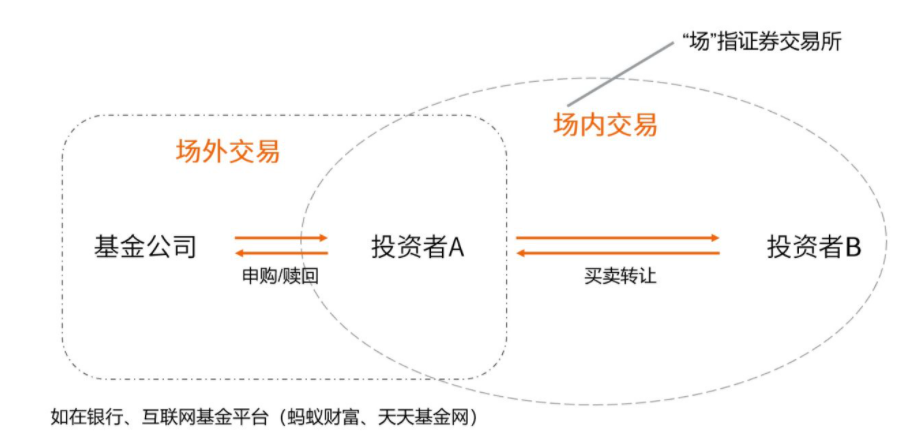
- “Market” here generally refers to the exchange.
1.4.1. Off-Exchange Funds
- Buy funds in the primary market, that is, directly from the fund company.
- After a fund company issues a fund, investors can buy from the fund company (subscribe) or sell back to it (redeem).
1.4.2. Exchange-Traded Funds
- Buy and sell funds in the secondary market. In most cases, investors buy fund units transferred by other investors, and these trades take place on a securities exchange.
- Classification
- LOF: listed open-ended fund.
- Off-exchange trading + on-exchange trading.
- ETF: exchange-traded open-ended fund. Whether it tracks an index depends on the specific product.
- Off-exchange + on-exchange trading. Off-exchange subscription/redemption uses in-kind exchange, using stocks for fund units.
- Structured funds.
- Closed-end funds.
- LOF: listed open-ended fund.
1.4.3. Exchange-Traded vs. Off-Exchange
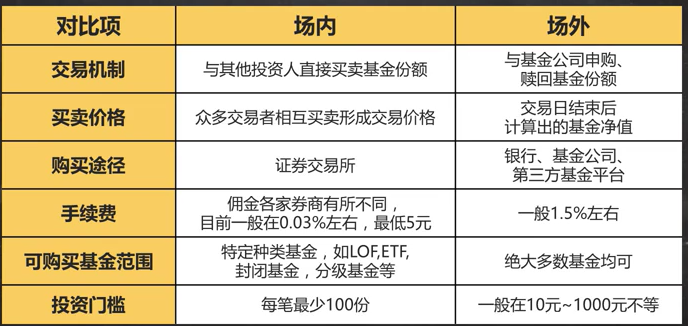
- Exchange-traded funds can trade at a premium because they trade in the secondary market.
- Exchange-traded fund prices are real-time, unlike off-exchange funds whose transaction price is calculated after 3 p.m. on a trading day.
- Exchange-traded is T+1 and off-exchange is T+2.
1.5. Classification by Management Style
1.5.1. Active
1.5.2. Passive (Index)
1.5.2.1. What Is an Index?
- An indicator describing changes in the overall price level of the stock market.
- For example, if the CSI 300 rises by 2, the corresponding stocks have risen by about 2% on average.
- In simple terms, select representative stocks and calculate a weighted average price.
1.5.2.2. Classification
1.5.2.2.1. ETF
- Exchange-traded, open-ended fund.
- Exchange-traded: can be listed and traded on a securities exchange.
- Open-ended: can be subscribed to and redeemed from the fund company.
- Passive: here it means an ETF that passively tracks an index.
1.5.2.2.2. LOF
- Listed and open-ended.
- Listed: can be listed and traded on a securities exchange.
- Open-ended: can be subscribed to and redeemed from the fund company.
- Can be either active or passive.
1.5.2.2.3. ETF vs. LOF
- Different substitutes are used for subscription/redemption.
- ETF uses “in-kind subscription, in-kind redemption,” while LOF uses “cash subscription, cash redemption.”
- LOF has a lower subscription threshold.
- ETF subscription thresholds are high, usually requiring more than RMB 1 million, while LOF thresholds are much lower (RMB 1,000 on-exchange and lower off-exchange).
- Different subscription/redemption venues.
- ETF subscription/redemption is handled through the exchange, while LOF can be handled both on-exchange and off-exchange.
1.5.2.2.4. Structured Funds
1.6. Classification by Investment Region
1.6.1. QDII Funds
1.6.1.1. Why They Exist
- Chinese residents have an annual convenience quota of USD 50,000 equivalent for foreign-exchange purchases, while direct overseas securities investment is also subject to capital-account and investment-channel restrictions.
1.6.1.2. What They Are
- Qualified Domestic Institutional Investor.
- Holding such a fund is equivalent to indirectly holding overseas assets and using it for overseas investment and asset allocation.
1.6.1.3. Classification
- QDII equity: examples include ICBC Credit Suisse Global Allocation or GF Nasdaq Index.
- QDII bond: ICBC Credit Suisse Global USD Bond.
- QDII mixed: Huatai-PineBridge Asian Enterprises.
- QDII alternative investment: E Fund Gold Theme or Penghua U.S. Real Estate.
1.6.1.4. Characteristics
1.6.1.4.1. Advantages
- Rich investment targets.
- Reduce single-market risk.
1.6.1.4.2. Disadvantages
- Exchange-rate risk (a double-edged sword).
- Higher overall fees.
- Longer subscription/redemption time.
Discussion
Sign in with GitHub to comment. Discussions are stored as GitHub Issues.View on GitHub