
NOTE
Business Cycles
English translation of the original VNote “Business Cycles”, preserving its structure and content.
This is a historical learning note and may contain outdated or incomplete understanding.
1. What Is a Business Cycle?
National income grows in the long run, but in the short run it shows cyclical upward and downward fluctuations.
In the short run, GDP growth fluctuates around the natural growth rate. When it is high, it is called economic overheating; when it is low, it is called an economic recession.
Why does a country’s output continuously fluctuate in the short run?
2. Classification of Business Cycles
- Kitchin cycle: 3 to 5 years (named after Joseph Kitchin).
- Juglar cycle: 7 to 11 years.
- Kuznets infrastructure-investment cycle: 15 to 25 years (named after Simon Kuznets, also called the “building cycle”).
- Kondratiev long wave: a technological cycle lasting 45 to 60 years (named after Soviet economist Nikolai Kondratiev).
3. Stages of the Business Cycle
- Stages of the business cycle: recession, recovery, overheating, stagflation.
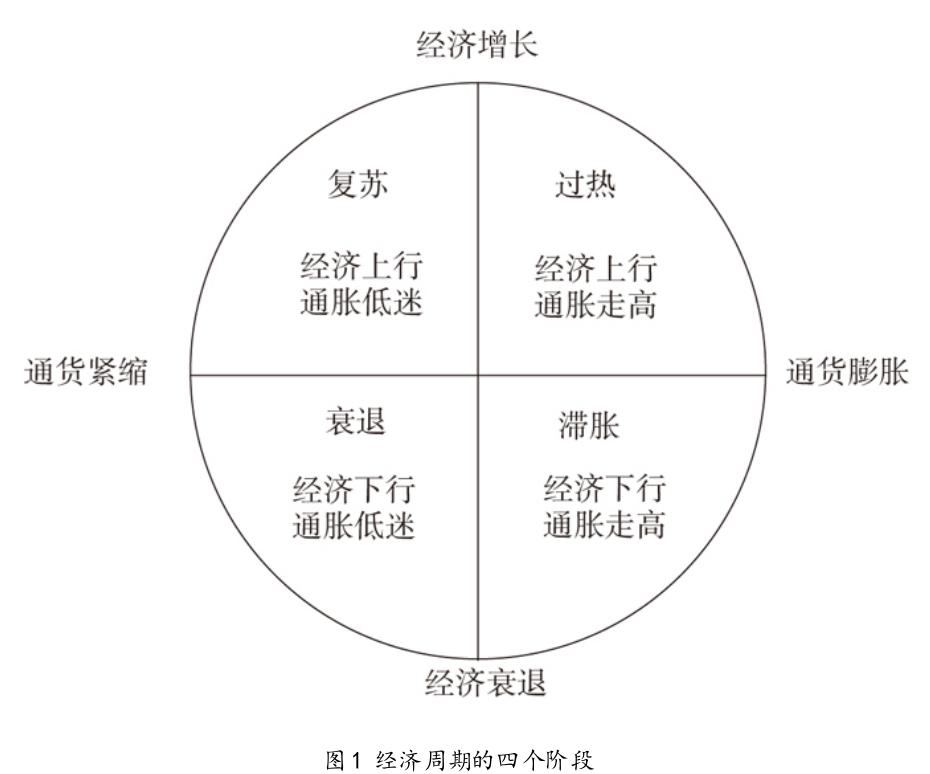
3.1. Merrill Lynch Investment Clock
The Merrill Lynch Investment Clock selects different investment products according to different stages of the economy.
- During recession, allocate bonds and cash.
- During recovery, allocate stocks and bonds: focus on financial stocks in the early stage, cyclical stocks in the middle stage, and technology stocks in the later stage.
- During overheating, allocate commodities and stocks: one category is commodity-related resource stocks such as coal, steel, and non-ferrous metals; another category is consumer stocks.
- During stagflation, allocate cash and commodities.
However, China is known as a policy-driven market. Policy intervention affects excessive reactions and clearing under market mechanisms, thereby weakening economic cyclicality and causing the Merrill Lynch clock to fail easily.
3.2. MVP
A variation of the Merrill Lynch clock: the MVP model: M = macro + V = valuation + P = policy.
- Macro: mainly look at the current stage of the economic cycle.
- Policy: mainly focus on the impact of monetary policy.
- Valuation: compare the stock market’s valuation range with its historical range and compare the attractiveness of stocks relative to bonds.
More specifically, by looking at the equity-bond risk premium, the stock market’s own relative valuation level, the deviation between market interest rates and policy interest rates, and the performance of growth and inflation factors, one can locate the overall macro characteristics and investment opportunities.
4. How to Judge the Business Cycle
Combine monetary policy and fiscal policy.
Discussion
Sign in with GitHub to comment. Discussions are stored as GitHub Issues.View on GitHub