
NOTE
Facade Pattern
Facade-pattern notes with UML plus Java and Go examples that wrap a complex process behind one interface.
This is a historical learning note and may contain outdated or incomplete understanding.
1. Definition
Encapsulate a complex process in one class, such as utility classes.
2. UML
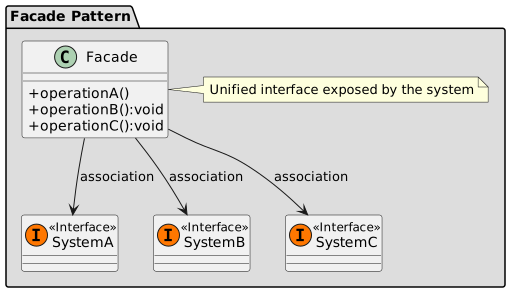
3. Java
3.1. Client
public class Client
{
    public static void main(String[] args)
    {
        Facade facade = new Facade();
        facade.run();
    }
}
3.2. Complex Process
public class Process1
{
    public void run()
    {
        System.out.println("Process1");
    }

}
public class Process2
{
public void run()
{
System.out.println("Process1");
}
}3.3. Facade
public class Facade
{
    public void run()
    {
        Process1 a = new Process1();
        Process2 b = new Process2();

        a.run();
        b.run();

    }
}
4. Golang
4.1. Complex Process
type ExportExcelUtilImpl struct {
}

func NewExportExcelUtilImpl() *ExportExcelUtilImpl {
	return &ExportExcelUtilImpl{}
}

func (e ExportExcelUtilImpl) Export() *Excel {
	excel := &Excel{}
	excel.Name = "export"
	// Read from the database
	data := e.readFromDB()
	// Render to Excel
	renderToExcel(excel, data)
	// Return Excel
	return excel
}

func (e ExportExcelUtilImpl) readFromDB() []byte {
	return nil
}

func renderToExcel(excel *Excel, data []byte) {
	excel.Data = data
}
4.2. Facade
/* Product returned by the utility class */
type Excel struct {
	Name string
	Data []byte
}

func (e Excel) ToString() string {
	return e.Name
}

/* Excel export utility */
type ExportExcelUtil interface {
	Export() Excel
}
4.3. Client
func main() {
	fmt.Println(structural.NewExportExcelUtilImpl().Export().ToString())
}
Discussion
Sign in with GitHub to comment. Discussions are stored as GitHub Issues.View on GitHub