
NOTE
State Pattern
The state pattern selects different processing logic according to the current state, with Java and Go examples.
This is a historical learning note and may contain outdated or incomplete understanding.
1. Definition
Select different processing logic according to different states; using if/else is too cumbersome.
The difference from the strategy pattern is that each strategy in the strategy pattern is used to accomplish the same thing, while the state pattern is used to accomplish different things.
2. UML
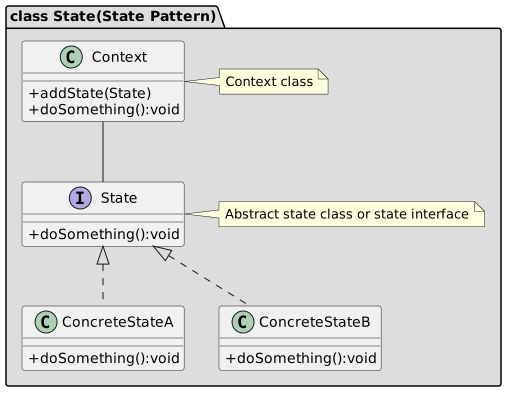
3. Java
3.1. Client
public class Client
{
    public static void main(String[] args)
    {
        Context context = new Context();
        context.setStatus(new FreeStatus());
        context.setStatus(new BookedStatus());
    }
}
3.2. Context
public class Context
{
    private Status status;

    public void setStatus(Status status)
    {
        // Change the state and trigger the behavior for that state
        this.status = status;
        this.status.handle();
    }
}
3.3. State
public interface Status
{
    void handle();
}
public class BookedStatus implements Status
{
@Override
public void handle()
{
System.out.println("room reserved");
}
}public class FreeStatus implements Status
{
@Override
public void handle()
{
System.out.println("room available");
}
}4. Golang
4.1. State
/* Ticket processing state */
type ITicketStatus interface {
	Handle()
}

// Process the ticket
type ProcessTicketStatus struct {
}

func NewProcessTicketStatus() *ProcessTicketStatus {
	return &ProcessTicketStatus{}
}

func (p *ProcessTicketStatus) Handle() {
	fmt.Println("process ticket")
}

/* Report ticket */
type ReportTicketStatus struct {
}

func NewReportTicketStatus() *ReportTicketStatus {
	return &ReportTicketStatus{}
}

func (r *ReportTicketStatus) Handle() {
	fmt.Println("report ticket")
}
4.2. State Management Class
/* Ticket-state management class */
type TicketStatusContext struct {
	status ITicketStatus
}

func NewTicketStatusContext() *TicketStatusContext {
	return &TicketStatusContext{}
}

func (t *TicketStatusContext) Status() ITicketStatus {
	return t.status
}

func (t *TicketStatusContext) SetStatus(status ITicketStatus) {
	t.status = status
}
4.3. Client
func main() {
	context := 状态模式.NewTicketStatusContext()

	context.SetStatus(状态模式.NewReportTicketStatus())
	context.Status().Handle()

	context.SetStatus(状态模式.NewProcessTicketStatus())
	context.Status().Handle()
}
Discussion
Sign in with GitHub to comment. Discussions are stored as GitHub Issues.View on GitHub