
NOTE
MyBatis Source Analysis
Framework layers, four core objects, SqlSessionFactory configuration parsing, SqlSession and Executor creation, mapper proxy creation, CRUD execution, mapped statements, first-level and second-level cache, and JDBC execution.
This is a historical learning note and may contain outdated or incomplete understanding.
1. Framework Layers
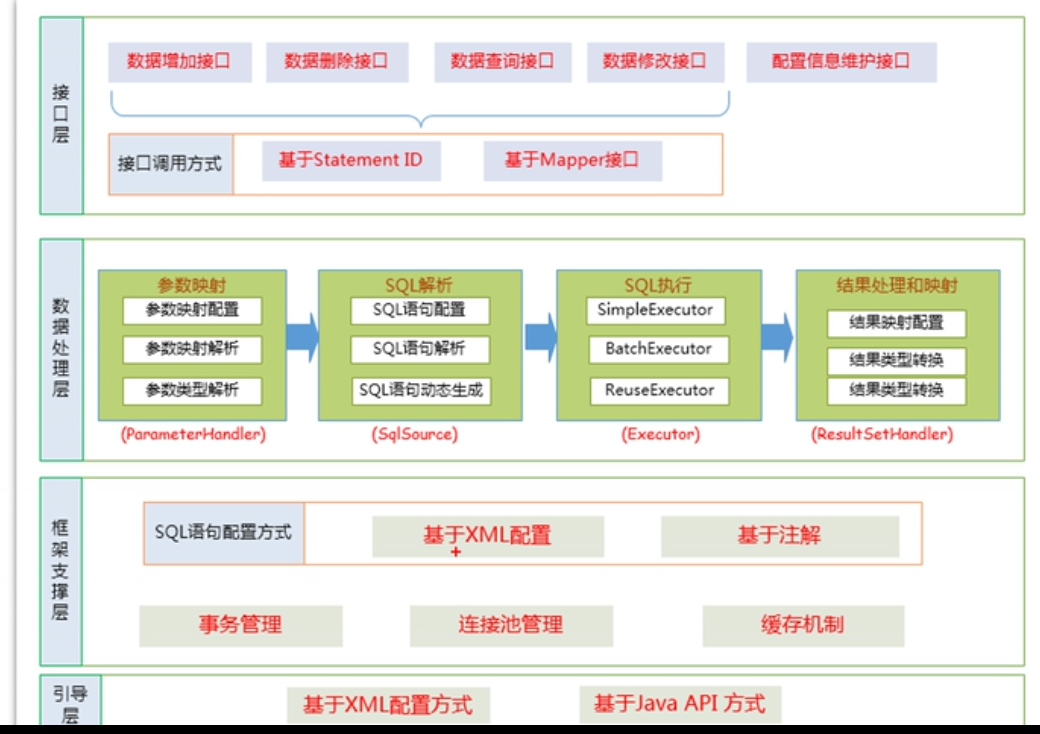
2. Four Core Objects
When MyBatis creates the four core objects, it uses the dynamic proxy mechanism to add interceptors.
- Executor
- ParameterHandler
- ResultSetHandler
- StatementHandler
3. Code to Analyze
public class Test
{
    public static void main(String[] args) throws Exception
    {
        String resource = "mybatis-config.xml";
        InputStream inputStream = Resources.getResourceAsStream(resource);
        // 1. Obtain the SqlSessionFactory object
        SqlSessionFactory sqlSessionFactory = new SqlSessionFactoryBuilder().build(inputStream);
        // 2. Obtain the SqlSession object
        SqlSession session = sqlSessionFactory.openSession();
        // 3. Obtain the proxy object for the interface
        TtestMapper mapper = session.getMapper(TtestMapper.class);
        // 4. Execute the CRUD method
        Ttest blog = mapper.getOne(1);
        System.out.println(blog);
        session.close();
    }
}
4. Obtain the SqlSessionFactory Object
new SqlSessionFactoryBuilder().build(inputStream)
public SqlSessionFactory build(InputStream inputStream, String environment, Properties properties) {
    try {
      // Read mybatis-config.xml and wrap the configuration information in XMLConfigBuilder
      XMLConfigBuilder parser = new XMLConfigBuilder(inputStream, environment, properties);
      // Wrap all configuration from the XML file into Configuration
      return build(parser.parse());
    } catch (Exception e) {
      throw ExceptionFactory.wrapException("Error building SqlSession.", e);
    } finally {
      ErrorContext.instance().reset();
      try {
        inputStream.close();
      } catch (IOException e) {
        // Intentionally ignore. Prefer previous error.
      }
    }
  }
4.1. Parse the XML Configuration
4.1.1. Parse the MyBatis Global Configuration
XMLConfigBuilder
public Configuration parse() {
    // If it has already been parsed, throw an exception directly
    if (parsed) {
      throw new BuilderException("Each XMLConfigBuilder can only be used once.");
    }
    parsed = true;
    // Use XPath to obtain the configuration node in mybatis-config.xml as the root node,
    // then continue parsing its child nodes
    parseConfiguration(parser.evalNode("/configuration"));
    return configuration;
  }

private void parseConfiguration(XNode root) {
    try {
      //issue #117 read properties first
      propertiesElement(root.evalNode("properties"));
      // Obtain the settings node and wrap it in Properties
      Properties settings = settingsAsProperties(root.evalNode("settings"));
      loadCustomVfs(settings);
      loadCustomLogImpl(settings);
      typeAliasesElement(root.evalNode("typeAliases"));
      pluginElement(root.evalNode("plugins"));
      objectFactoryElement(root.evalNode("objectFactory"));
      objectWrapperFactoryElement(root.evalNode("objectWrapperFactory"));
      reflectorFactoryElement(root.evalNode("reflectorFactory"));
      // Set all properties under the settings node into Configuration
      settingsElement(settings);
      // read it after objectFactory and objectWrapperFactory issue #631
      environmentsElement(root.evalNode("environments"));
      databaseIdProviderElement(root.evalNode("databaseIdProvider"));
      typeHandlerElement(root.evalNode("typeHandlers"));
      // Parse the mappers tag
      mapperElement(root.evalNode("mappers"));
    } catch (Exception e) {
      throw new BuilderException("Error parsing SQL Mapper Configuration. Cause: " + e, e);
    }
  }

private void settingsElement(Properties props) {
    // If a property is absent, use its default value
    configuration.setAutoMappingBehavior(AutoMappingBehavior.valueOf(props.getProperty("autoMappingBehavior", "PARTIAL")));
    configuration.setAutoMappingUnknownColumnBehavior(AutoMappingUnknownColumnBehavior.valueOf(props.getProperty("autoMappingUnknownColumnBehavior", "NONE")));
    configuration.setCacheEnabled(booleanValueOf(props.getProperty("cacheEnabled"), true));
    configuration.setProxyFactory((ProxyFactory) createInstance(props.getProperty("proxyFactory")));
    configuration.setLazyLoadingEnabled(booleanValueOf(props.getProperty("lazyLoadingEnabled"), false));
    configuration.setAggressiveLazyLoading(booleanValueOf(props.getProperty("aggressiveLazyLoading"), false));
    configuration.setMultipleResultSetsEnabled(booleanValueOf(props.getProperty("multipleResultSetsEnabled"), true));
    configuration.setUseColumnLabel(booleanValueOf(props.getProperty("useColumnLabel"), true));
    configuration.setUseGeneratedKeys(booleanValueOf(props.getProperty("useGeneratedKeys"), false));
    configuration.setDefaultExecutorType(ExecutorType.valueOf(props.getProperty("defaultExecutorType", "SIMPLE")));
    configuration.setDefaultStatementTimeout(integerValueOf(props.getProperty("defaultStatementTimeout"), null));
    configuration.setDefaultFetchSize(integerValueOf(props.getProperty("defaultFetchSize"), null));
    configuration.setMapUnderscoreToCamelCase(booleanValueOf(props.getProperty("mapUnderscoreToCamelCase"), false));
    configuration.setSafeRowBoundsEnabled(booleanValueOf(props.getProperty("safeRowBoundsEnabled"), false));
    configuration.setLocalCacheScope(LocalCacheScope.valueOf(props.getProperty("localCacheScope", "SESSION")));
    configuration.setJdbcTypeForNull(JdbcType.valueOf(props.getProperty("jdbcTypeForNull", "OTHER")));
    configuration.setLazyLoadTriggerMethods(stringSetValueOf(props.getProperty("lazyLoadTriggerMethods"), "equals,clone,hashCode,toString"));
    configuration.setSafeResultHandlerEnabled(booleanValueOf(props.getProperty("safeResultHandlerEnabled"), true));
    configuration.setDefaultScriptingLanguage(resolveClass(props.getProperty("defaultScriptingLanguage")));
    configuration.setDefaultEnumTypeHandler(resolveClass(props.getProperty("defaultEnumTypeHandler")));
    configuration.setCallSettersOnNulls(booleanValueOf(props.getProperty("callSettersOnNulls"), false));
    configuration.setUseActualParamName(booleanValueOf(props.getProperty("useActualParamName"), true));
    configuration.setReturnInstanceForEmptyRow(booleanValueOf(props.getProperty("returnInstanceForEmptyRow"), false));
    configuration.setLogPrefix(props.getProperty("logPrefix"));
    configuration.setConfigurationFactory(resolveClass(props.getProperty("configurationFactory")));
  }


  private void mapperElement(XNode parent) throws Exception {
    if (parent != null) {
      for (XNode child : parent.getChildren()) {
      // If there is a package node, use the following logic
        if ("package".equals(child.getName())) {
          String mapperPackage = child.getStringAttribute("name");
          configuration.addMappers(mapperPackage);
        } else {
          // Decide which branch to use according to resource, url, and class
          String resource = child.getStringAttribute("resource");
          String url = child.getStringAttribute("url");
          String mapperClass = child.getStringAttribute("class");
          if (resource != null && url == null && mapperClass == null) {
            ErrorContext.instance().resource(resource);
            InputStream inputStream = Resources.getResourceAsStream(resource);
            XMLMapperBuilder mapperParser = new XMLMapperBuilder(inputStream, configuration, resource, configuration.getSqlFragments());
            // Parse the mapper tag
            mapperParser.parse();
          } else if (resource == null && url != null && mapperClass == null) {
            ErrorContext.instance().resource(url);
            InputStream inputStream = Resources.getUrlAsStream(url);
            XMLMapperBuilder mapperParser = new XMLMapperBuilder(inputStream, configuration, url, configuration.getSqlFragments());
            mapperParser.parse();
          } else if (resource == null && url == null && mapperClass != null) {
            // <mapper class="com.zsk.test.mapper.TtestMapper"></mapper>
            // Create the Class object and load it into Configuration
            Class<?> mapperInterface = Resources.classForName(mapperClass);
            configuration.addMapper(mapperInterface);
          } else {
            throw new BuilderException("A mapper element may only specify a url, resource or class, but not more than one.");
          }
        }
      }
    }
  }
4.1.2. Parse mapper.xml
XMLMapperBuilder
public void parse() {
    if (!configuration.isResourceLoaded(resource)) {
      // mapper tag
      configurationElement(parser.evalNode("/mapper"));
      configuration.addLoadedResource(resource);
      bindMapperForNamespace();
    }

    parsePendingResultMaps();
    parsePendingCacheRefs();
    parsePendingStatements();
  }

private void configurationElement(XNode context) {
    try {
      String namespace = context.getStringAttribute("namespace");
      if (namespace == null || namespace.equals("")) {
        throw new BuilderException("Mapper's namespace cannot be empty");
      }

      builderAssistant.setCurrentNamespace(namespace);
      cacheRefElement(context.evalNode("cache-ref"));
      cacheElement(context.evalNode("cache"));
      // Parse parameterMap, resultMap, and sql tags and store them in Configuration
      parameterMapElement(context.evalNodes("/mapper/parameterMap"));
      resultMapElements(context.evalNodes("/mapper/resultMap"));
      sqlElement(context.evalNodes("/mapper/sql"));
      // Parse CRUD tags
      buildStatementFromContext(context.evalNodes("select|insert|update|delete"));
    } catch (Exception e) {
      throw new BuilderException("Error parsing Mapper XML. The XML location is '" + resource + "'. Cause: " + e, e);
    }
    }

private void buildStatementFromContext(List<XNode> list) {
    if (configuration.getDatabaseId() != null) {
      buildStatementFromContext(list, configuration.getDatabaseId());
    }
    buildStatementFromContext(list, null);
}

private void buildStatementFromContext(List<XNode> list, String requiredDatabaseId) {
    for (XNode context : list) {
      final XMLStatementBuilder statementParser = new XMLStatementBuilder(configuration, builderAssistant, context, requiredDatabaseId);
      try {
        statementParser.parseStatementNode();
      } catch (IncompleteElementException e) {
        configuration.addIncompleteStatement(statementParser);
      }
    }
}

public void parseStatementNode() {
    String id = context.getStringAttribute("id");
    String databaseId = context.getStringAttribute("databaseId");

    if (!databaseIdMatchesCurrent(id, databaseId, this.requiredDatabaseId)) {
      return;
    }

    String nodeName = context.getNode().getNodeName();
    SqlCommandType sqlCommandType = SqlCommandType.valueOf(nodeName.toUpperCase(Locale.ENGLISH));
    boolean isSelect = sqlCommandType == SqlCommandType.SELECT;
    boolean flushCache = context.getBooleanAttribute("flushCache", !isSelect);
    boolean useCache = context.getBooleanAttribute("useCache", isSelect);
    boolean resultOrdered = context.getBooleanAttribute("resultOrdered", false);

    // Include Fragments before parsing
    XMLIncludeTransformer includeParser = new XMLIncludeTransformer(configuration, builderAssistant);
    includeParser.applyIncludes(context.getNode());

    String parameterType = context.getStringAttribute("parameterType");
    Class<?> parameterTypeClass = resolveClass(parameterType);

    String lang = context.getStringAttribute("lang");
    LanguageDriver langDriver = getLanguageDriver(lang);

    // Parse selectKey after includes and remove them.
    processSelectKeyNodes(id, parameterTypeClass, langDriver);

    // Parse the SQL (pre: <selectKey> and <include> were parsed and removed)
    KeyGenerator keyGenerator;
    String keyStatementId = id + SelectKeyGenerator.SELECT_KEY_SUFFIX;
    keyStatementId = builderAssistant.applyCurrentNamespace(keyStatementId, true);
    if (configuration.hasKeyGenerator(keyStatementId)) {
      keyGenerator = configuration.getKeyGenerator(keyStatementId);
    } else {
      keyGenerator = context.getBooleanAttribute("useGeneratedKeys",
          configuration.isUseGeneratedKeys() && SqlCommandType.INSERT.equals(sqlCommandType))
          ? Jdbc3KeyGenerator.INSTANCE : NoKeyGenerator.INSTANCE;
    }

    SqlSource sqlSource = langDriver.createSqlSource(configuration, context, parameterTypeClass);
    StatementType statementType = StatementType.valueOf(context.getStringAttribute("statementType", StatementType.PREPARED.toString()));
    Integer fetchSize = context.getIntAttribute("fetchSize");
    Integer timeout = context.getIntAttribute("timeout");
    String parameterMap = context.getStringAttribute("parameterMap");
    String resultType = context.getStringAttribute("resultType");
    Class<?> resultTypeClass = resolveClass(resultType);
    String resultMap = context.getStringAttribute("resultMap");
    String resultSetType = context.getStringAttribute("resultSetType");
    ResultSetType resultSetTypeEnum = resolveResultSetType(resultSetType);
    String keyProperty = context.getStringAttribute("keyProperty");
    String keyColumn = context.getStringAttribute("keyColumn");
    String resultSets = context.getStringAttribute("resultSets");

    // Finally wrap it as a MappedStatement object
    builderAssistant.addMappedStatement(id, sqlSource, statementType, sqlCommandType,
        fetchSize, timeout, parameterMap, parameterTypeClass, resultMap, resultTypeClass,
        resultSetTypeEnum, flushCache, useCache, resultOrdered,
        keyGenerator, keyProperty, keyColumn, databaseId, langDriver, resultSets);
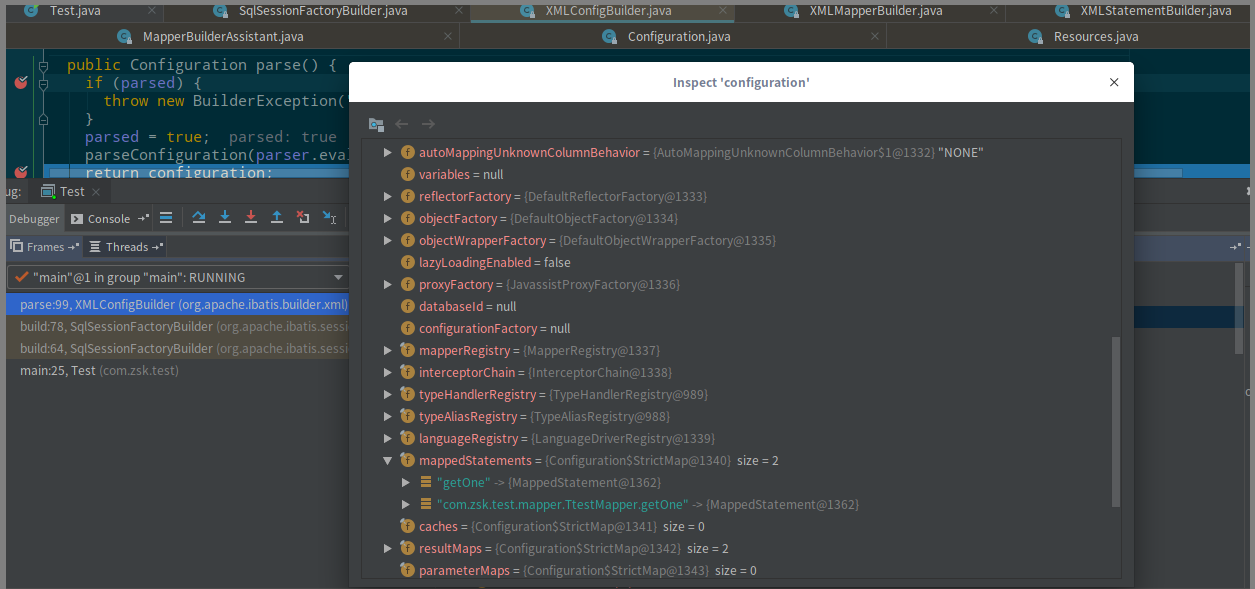
  }
5. Obtain the SqlSession Object
DefaultSqlSessionFactory.openSession()
public class DefaultSqlSessionFactory implements SqlSessionFactory {
     @Override
     public SqlSession openSession() {
        // Obtain SqlSession according to ExecutorType configured in Configuration (SIMPLE by default)
        return openSessionFromDataSource(configuration.getDefaultExecutorType(), null, false);
        }

 private SqlSession openSessionFromDataSource(ExecutorType execType, TransactionIsolationLevel level, boolean autoCommit) {
    Transaction tx = null;
    try {
        // Obtain database connection information from Configuration
      final Environment environment = configuration.getEnvironment();
      // Create transaction
      final TransactionFactory transactionFactory = getTransactionFactoryFromEnvironment(environment);
      tx = transactionFactory.newTransaction(environment.getDataSource(), level, autoCommit);
      // Create Executor
      final Executor executor = configuration.newExecutor(tx, execType);
      // The returned SqlSession ultimately contains Configuration and Executor information
      return new DefaultSqlSession(configuration, executor, autoCommit);
    } catch (Exception e) {
      closeTransaction(tx); // may have fetched a connection so lets call close()
      throw ExceptionFactory.wrapException("Error opening session.  Cause: " + e, e);
    } finally {
      ErrorContext.instance().reset();
    }
  }
}
5.1. Obtain Database Connection Information
5.2. Create the Transaction Management Factory
5.3. Create Executor
Configuration
public class Configuration {

    public Executor newExecutor(Transaction transaction, ExecutorType executorType) {
        // Default is ExecutorType.SIMPLE
        executorType = executorType == null ? defaultExecutorType : executorType;
        executorType = executorType == null ? ExecutorType.SIMPLE : executorType;
        Executor executor;
        // Create different Executors according to type
        if (ExecutorType.BATCH == executorType) {
          executor = new BatchExecutor(this, transaction);
        } else if (ExecutorType.REUSE == executorType) {
          executor = new ReuseExecutor(this, transaction);
        } else {
          executor = new SimpleExecutor(this, transaction);
        }
        // Decorator pattern: wrap the original Executor with Cache
        if (cacheEnabled) {
          executor = new CachingExecutor(executor);
        }
        // Also the decorator pattern? -- wrap all plugins around Executor
        executor = (Executor) interceptorChain.pluginAll(executor);
        return executor;
      }
}
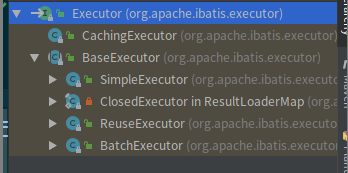
5.3.1. Executor Inheritance Hierarchy
6. Obtain the Proxy Object of the Mapper Class
DefaultSqlSession.getMapper(TtestMapper.class)
@Override
  public <T> T getMapper(Class<T> type) {
    // Call Configuration.getMapper
    return configuration.getMapper(type, this);
  }
6.1. Obtain MapperProxyFactory from MapperRegistry by Mapper Name
Configuration
public <T> T getMapper(Class<T> type, SqlSession sqlSession) {
    // Call MapperRegistry.getMapper
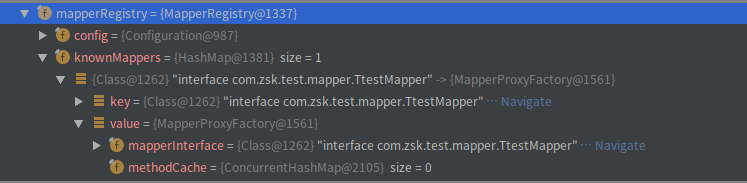
    // MapperRegistry stores Mapper name : MapperProxyFactory
    return mapperRegistry.getMapper(type, sqlSession);
  }
MapperRegistry
@SuppressWarnings("unchecked")
  public <T> T getMapper(Class<T> type, SqlSession sqlSession) {
    // Obtain MapperProxyFactory from Map<Class<?>, MapperProxyFactory<?>> knownMappers = new HashMap<>();
    final MapperProxyFactory<T> mapperProxyFactory = (MapperProxyFactory<T>) knownMappers.get(type);
    // Throw an exception if it is not found
    if (mapperProxyFactory == null) {
      throw new BindingException("Type " + type + " is not known to the MapperRegistry.");
    }
    try {
      return mapperProxyFactory.newInstance(sqlSession);
    } catch (Exception e) {
      throw new BindingException("Error getting mapper instance. Cause: " + e, e);
    }
  }
6.2. Use MapperProxyFactory and JDK Dynamic Proxying to Create the Mapper
MapperProxyFactory
 public T newInstance(SqlSession sqlSession) {
    // class MapperProxy<T> implements InvocationHandler, the JDK dynamic-proxy interface
    final MapperProxy<T> mapperProxy = new MapperProxy<>(sqlSession, mapperInterface, methodCache);
    return newInstance(mapperProxy);
  }

  @SuppressWarnings("unchecked")
  protected T newInstance(MapperProxy<T> mapperProxy) {
    // Parameters: class loader of the proxied object, interfaces implemented by the proxied object,
    // and proxy-handler instance
    return (T) Proxy.newProxyInstance(mapperInterface.getClassLoader(), new Class[] { mapperInterface }, mapperProxy);
  }
7. Execute CRUD Methods Through the Proxy Object
MapperProxy.getOne(1)
 // The proxy class's invoke method is called
 @Override
  public Object invoke(Object proxy, Method method, Object[] args) throws Throwable {
    try {
      // If this method is an Object method, call it directly
      if (Object.class.equals(method.getDeclaringClass())) {
        return method.invoke(this, args);
        // Determine whether it is a default interface method
      } else if (isDefaultMethod(method)) {
        return invokeDefaultMethod(proxy, method, args);
      }
    } catch (Throwable t) {
      throw ExceptionUtil.unwrapThrowable(t);
    }
    // Obtain MapperMethod from the cache
    final MapperMethod mapperMethod = cachedMapperMethod(method);
    // Execute the SQL statement
    return mapperMethod.execute(sqlSession, args);
  }

 private MapperMethod cachedMapperMethod(Method method) {
    // If the method exists in the Map, return it directly; otherwise create it and return it
    return methodCache.computeIfAbsent(method, k -> new MapperMethod(mapperInterface, method, sqlSession.getConfiguration()));
  }
7.1. Execute SQL Through MapperMethod
MapperMethod
public class MapperMethod {

  private final SqlCommand command;
  private final MethodSignature method;

  public MapperMethod(Class<?> mapperInterface, Method method, Configuration config) {
    // Wrap the SQL statement
    this.command = new SqlCommand(config, mapperInterface, method);
    // Wrap the parameters of the SQL statement
    this.method = new MethodSignature(config, mapperInterface, method);
  }


  public Object execute(SqlSession sqlSession, Object[] args) {
    Object result;
    // Call CRUD according to the type of SQL statement
    switch (command.getType()) {
      case INSERT: {
        Object param = method.convertArgsToSqlCommandParam(args);
        result = rowCountResult(sqlSession.insert(command.getName(), param));
        break;
      }
      case UPDATE: {
        Object param = method.convertArgsToSqlCommandParam(args);
        result = rowCountResult(sqlSession.update(command.getName(), param));
        break;
      }
      case DELETE: {
        Object param = method.convertArgsToSqlCommandParam(args);
        result = rowCountResult(sqlSession.delete(command.getName(), param));
        break;
      }
      case SELECT:
        // No return value
        if (method.returnsVoid() && method.hasResultHandler()) {
          executeWithResultHandler(sqlSession, args);
          result = null;
        // Return multiple values
        } else if (method.returnsMany()) {
          result = executeForMany(sqlSession, args);
        // Return a map
        } else if (method.returnsMap()) {
          result = executeForMap(sqlSession, args);
        // Return a cursor -- pagination?
        } else if (method.returnsCursor()) {
          result = executeForCursor(sqlSession, args);
        // Return one value
        } else {
          Object param = method.convertArgsToSqlCommandParam(args);
          // Call SqlSession.selectOne
          result = sqlSession.selectOne(command.getName(), param);
          if (method.returnsOptional()
              && (result == null || !method.getReturnType().equals(result.getClass()))) {
            result = Optional.ofNullable(result);
          }
        }
        break;
      case FLUSH:
        result = sqlSession.flushStatements();
        break;
      default:
        throw new BindingException("Unknown execution method for: " + command.getName());
    }
    if (result == null && method.getReturnType().isPrimitive() && !method.returnsVoid()) {
      throw new BindingException("Mapper method '" + command.getName()
          + " attempted to return null from a method with a primitive return type (" + method.getReturnType() + ").");
    }
    return result;
  }
}
7.2. How Is the SQL Executed?
DefaultSqlSession
  @Override
  public <T> T selectOne(String statement, Object parameter) {
    // Popular vote was to return null on 0 results and throw exception on too many.
    // All of them call the list method
    List<T> list = this.selectList(statement, parameter);
    // If there is one result, return it directly
    if (list.size() == 1) {
      return list.get(0);
    // More than one is a problem; throw an exception
    } else if (list.size() > 1) {
      throw new TooManyResultsException("Expected one result (or null) to be returned by selectOne(), but found: " + list.size());
    // If there are none, return null
    } else {
      return null;
    }
  }

  @Override
  public <E> List<E> selectList(String statement, Object parameter) {
    return this.selectList(statement, parameter, RowBounds.DEFAULT);
  }

  @Override
  public <E> List<E> selectList(String statement, Object parameter, RowBounds rowBounds) {
    try {
      // Call Configuration to wrap the SQL and parameters as a MappedStatement
      MappedStatement ms = configuration.getMappedStatement(statement);
      // Execute through the Executor
      return executor.query(ms, wrapCollection(parameter), rowBounds, Executor.NO_RESULT_HANDLER);
    } catch (Exception e) {
      throw ExceptionFactory.wrapException("Error querying database.  Cause: " + e, e);
    } finally {
      ErrorContext.instance().reset();
    }
  }
7.2.1. Wrap the SQL Statement as MappedStatement
Configuration
public MappedStatement getMappedStatement(String id) {
    return this.getMappedStatement(id, true);
  }

public MappedStatement getMappedStatement(String id, boolean validateIncompleteStatements) {
    // If this statement has not been generated, rebuild it and put it into the Map
    if (validateIncompleteStatements) {
      buildAllStatements();
    }
    // Take the statement from the Map to avoid repeated parsing
    return mappedStatements.get(id);
  }
7.2.2. Execute SQL Through Executor
7.2.2.1. If It Exists in the Second-Level Cache, Return It Directly
CachingExecutor
  @Override
  public <E> List<E> query(MappedStatement ms, Object parameterObject, RowBounds rowBounds, ResultHandler resultHandler) throws SQLException {
    // Obtain SQL
    BoundSql boundSql = ms.getBoundSql(parameterObject);
    // Construct the cache key
    CacheKey key = createCacheKey(ms, parameterObject, rowBounds, boundSql);
    return query(ms, parameterObject, rowBounds, resultHandler, key, boundSql);
  }

   @Override
  public <E> List<E> query(MappedStatement ms, Object parameterObject, RowBounds rowBounds, ResultHandler resultHandler, CacheKey key, BoundSql boundSql)
      throws SQLException {
    Cache cache = ms.getCache();
    // Cache exists
    if (cache != null) {
      flushCacheIfRequired(ms);
      if (ms.isUseCache() && resultHandler == null) {
        ensureNoOutParams(ms, boundSql);
        @SuppressWarnings("unchecked")
        // Obtain it from cache
        List<E> list = (List<E>) tcm.getObject(cache, key);
        // Nothing was obtained
        if (list == null) {
          // Re-execute SQL and put it into cache again
          list = delegate.query(ms, parameterObject, rowBounds, resultHandler, key, boundSql);
          tcm.putObject(cache, key, list); // issue #578 and #116
        }
        return list;
      }
    }
    // BaseExecutor.query
    return delegate.query(ms, parameterObject, rowBounds, resultHandler, key, boundSql);
  }
7.2.2.2. If It Exists in the First-Level Cache, Return It Directly; Otherwise Query the Database
BaseExecutor
@SuppressWarnings("unchecked")
  @Override
  public <E> List<E> query(MappedStatement ms, Object parameter, RowBounds rowBounds, ResultHandler resultHandler, CacheKey key, BoundSql boundSql) throws SQLException {
    ErrorContext.instance().resource(ms.getResource()).activity("executing a query").object(ms.getId());
    if (closed) {
      throw new ExecutorException("Executor was closed.");
    }
    if (queryStack == 0 && ms.isFlushCacheRequired()) {
      clearLocalCache();
    }
    List<E> list;
    try {
      queryStack++;
      // First-level cache?
      list = resultHandler == null ? (List<E>) localCache.getObject(key) : null;
      if (list != null) {
        handleLocallyCachedOutputParameters(ms, key, parameter, boundSql);
      } else {
        // Query from the database
        list = queryFromDatabase(ms, parameter, rowBounds, resultHandler, key, boundSql);
      }
    } finally {
      queryStack--;
    }
    if (queryStack == 0) {
      for (DeferredLoad deferredLoad : deferredLoads) {
        deferredLoad.load();
      }
      // issue #601
      deferredLoads.clear();
      if (configuration.getLocalCacheScope() == LocalCacheScope.STATEMENT) {
        // issue #482
        clearLocalCache();
      }
    }
    return list;
  }


  private <E> List<E> queryFromDatabase(MappedStatement ms, Object parameter, RowBounds rowBounds, ResultHandler resultHandler, CacheKey key, BoundSql boundSql) throws SQLException {
    List<E> list;
    localCache.putObject(key, EXECUTION_PLACEHOLDER);
    try {
      // SimpleExecutor
      list = doQuery(ms, parameter, rowBounds, resultHandler, boundSql);
    } finally {
      localCache.removeObject(key);
    }
    localCache.putObject(key, list);
    if (ms.getStatementType() == StatementType.CALLABLE) {
      localOutputParameterCache.putObject(key, parameter);
    }
    return list;
  }
7.2.2.3. The Actual JDBC Operation
SimpleExecutor
@Override
  public <E> List<E> doQuery(MappedStatement ms, Object parameter, RowBounds rowBounds, ResultHandler resultHandler, BoundSql boundSql) throws SQLException {
    Statement stmt = null;
    try {
      Configuration configuration = ms.getConfiguration();
      StatementHandler handler = configuration.newStatementHandler(wrapper, ms, parameter, rowBounds, resultHandler, boundSql);
      // JDBC operation
      stmt = prepareStatement(handler, ms.getStatementLog());
      return handler.query(stmt, resultHandler);
    } finally {
      closeStatement(stmt);
    }
  }
Discussion
Sign in with GitHub to comment. Discussions are stored as GitHub Issues.View on GitHub