
NOTE
6.16 ConcurrentHashMap in JDK 1.7
1. Constructor 2. put method 2.1. hash 2.2. ensureSegment 2.3. Segment.put 2.3.1. scanAndLockForPut 2.3.2. rehash 3. get 4. containsKey 5. remove 5.1. segmentForHash 5.2. Segment.remove
This is a historical learning note and may contain outdated or incomplete understanding.
1. Constructor
public ConcurrentHashMap() {
    // 16, 0.75f, 16
    this(DEFAULT_INITIAL_CAPACITY, DEFAULT_LOAD_FACTOR, DEFAULT_CONCURRENCY_LEVEL);
}
2. The put Method
public V put(K key, V value) {
    Segment<K,V> s;
    // value cannot be null
    if (value == null)
        throw new NullPointerException();
    // Calculate the hash value of the key
    int hash = hash(key);
    // Then use the hash value to calculate j
    int j = (hash >>> segmentShift) & segmentMask;
    if ((s = (Segment<K,V>)UNSAFE.getObject          // nonvolatile; recheck
         // Use j to calculate the address and obtain the Segment object with CAS
         (segments, (j << SSHIFT) + SBASE)) == null) // in ensureSegment
        // Initialize
        s = ensureSegment(j);
    // Call Segment.put
    return s.put(key, hash, value, false);
}
2.1. hash
private int hash(Object k) {
    int h = hashSeed;

    if ((0 != h) && (k instanceof String)) {
        return sun.misc.Hashing.stringHash32((String) k);
    }

    h ^= k.hashCode();

    // Spread bits to regularize both segment and index locations,
    // using variant of single-word Wang/Jenkins hash.
    h += (h <<  15) ^ 0xffffcd7d;
    h ^= (h >>> 10);
    h += (h <<   3);
    h ^= (h >>>  6);
    h += (h <<   2) + (h << 14);
    return h ^ (h >>> 16);
}
2.2. ensureSegment
private Segment<K,V> ensureSegment(int k) {
    final Segment<K,V>[] ss = this.segments;
    long u = (k << SSHIFT) + SBASE; // raw offset
    Segment<K,V> seg;
    // The Segment is null and needs to be initialized.
    // Why use CAS instead of directly using the array index???
    if ((seg = (Segment<K,V>)UNSAFE.getObjectVolatile(ss, u)) == null) {
        // Prototype pattern: use the first Segment as the prototype
        Segment<K,V> proto = ss[0]; // use segment 0 as prototype
        // Get the capacity, loadFactor, and threshold of the first Segment
        // (used later to create the entry table and Segment)
        int cap = proto.table.length;
        float lf = proto.loadFactor;
        int threshold = (int)(cap * lf);

        // Create the entry table (used later to create the Segment)
        HashEntry<K,V>[] tab = (HashEntry<K,V>[])new HashEntry[cap];
        // Recheck that it is still null. If it is not null, another thread has already initialized it,
        // so exit directly to avoid wasting CPU in an infinite loop + CAS
        if ((seg = (Segment<K,V>)UNSAFE.getObjectVolatile(ss, u))
            == null) { // recheck
            // Create the Segment
            Segment<K,V> s = new Segment<K,V>(lf, threshold, tab);
            // Infinite loop + CAS to set the Segment
            while ((seg = (Segment<K,V>)UNSAFE.getObjectVolatile(ss, u))
                   == null) {
                if (UNSAFE.compareAndSwapObject(ss, u, null, seg = s))
                    break;
            }
        }
    }
    return seg;
}
2.3. The Segment.put Method
final V put(K key, int hash, V value, boolean onlyIfAbsent) {
        // First call sync.nonfairTryAcquire(1) to try to acquire the lock quickly
        HashEntry<K,V> node = tryLock() ? null :
            scanAndLockForPut(key, hash, value);
        V oldValue;
        try {
            // Calculate the index
            HashEntry<K,V>[] tab = table;
            int index = (tab.length - 1) & hash;
            // Head node
            HashEntry<K,V> first = entryAt(tab, index);
            // Traverse the linked list
            for (HashEntry<K,V> e = first;;) {
                // The linked list is not empty
                if (e != null) {
                    K k;
                    // Found an equal node
                    if ((k = e.key) == key ||
                        (e.hash == hash && key.equals(k))) {
                        oldValue = e.value;
                        // Replace value
                        if (!onlyIfAbsent) {
                            e.value = value;
                            ++modCount;
                        }
                        break;
                    }
                    e = e.next;
                }
                // The linked list is empty
                else
                {
                    // The node was already found above
                    if (node != null)
                        node.setNext(first);
                    else
                        node = new HashEntry<K,V>(hash, key, value, first);
                    // Increment the count
                    int c = count + 1;
                    // The count now exceeds threshold
                    if (c > threshold && tab.length < MAXIMUM_CAPACITY)
                        // Resize
                        rehash(node);
                    else
                        // CAS-set the head node
                        setEntryAt(tab, index, node);
                    ++modCount;
                    count = c;
                    oldValue = null;
                    break;
                }
            }
        } finally {
            // Unlock
            unlock();
        }
        return oldValue;
    }
2.3.1. scanAndLockForPut
private HashEntry<K,V> scanAndLockForPut(K key, int hash, V value) {
        HashEntry<K,V> first = entryForHash(this, hash);
        HashEntry<K,V> e = first;
        HashEntry<K,V> node = null;
        int retries = -1; // negative while locating node
        // Infinite loop until the lock is acquired
        while (!tryLock()) {
            HashEntry<K,V> f; // to recheck first below
            if (retries < 0) {
                // The linked-list head is null
                if (e == null) {
                    if (node == null) // speculatively create node
                        node = new HashEntry<K,V>(hash, key, value, null);
                    retries = 0;
                }
                // Found an equal node
                else if (key.equals(e.key))
                    retries = 0;
                // Next node in the linked list
                else
                    e = e.next;
            }
            // Too many loops: upgrade to blocking lock acquisition
            else if (++retries > MAX_SCAN_RETRIES) {
                lock();
                break;
            }
            else if ((retries & 1) == 0 &&
                     (f = entryForHash(this, hash)) != first) {
                e = first = f; // re-traverse if entry changed
                retries = -1;
            }
        }
        return node;
    }
2.3.2. rehash
private void rehash(HashEntry<K,V> node) {
        /*
         * Reclassify nodes in each list to new table.  Because we
         * are using power-of-two expansion, the elements from
         * each bin must either stay at same index, or move with a
         * power of two offset. We eliminate unnecessary node
         * creation by catching cases where old nodes can be
         * reused because their next fields won't change.
         * Statistically, at the default threshold, only about
         * one-sixth of them need cloning when a table
         * doubles. The nodes they replace will be garbage
         * collectable as soon as they are no longer referenced by
         * any reader thread that may be in the midst of
         * concurrently traversing table. Entry accesses use plain
         * array indexing because they are followed by volatile
         * table write.
         */
        HashEntry<K,V>[] oldTable = table;
        int oldCapacity = oldTable.length;
        // New capacity = old capacity * 2
        int newCapacity = oldCapacity << 1;
        threshold = (int)(newCapacity * loadFactor);
        // Create a new entry array using the new capacity
        HashEntry<K,V>[] newTable =
            (HashEntry<K,V>[]) new HashEntry[newCapacity];
        int sizeMask = newCapacity - 1;
        // Traverse every element in the original array
        for (int i = 0; i < oldCapacity ; i++) {
            HashEntry<K,V> e = oldTable[i];
            if (e != null) {
                HashEntry<K,V> next = e.next;
                // Calculate its position in the new array
                int idx = e.hash & sizeMask;
                // Only one node
                if (next == null)   // Single node on list
                    newTable[idx] = e;
                else { // Reuse consecutive sequence at same slot
                    HashEntry<K,V> lastRun = e;
                    int lastIdx = idx;
                    // Traverse the linked list
                    for (HashEntry<K,V> last = next;
                         last != null;
                         last = last.next) {
                        int k = last.hash & sizeMask;
                        if (k != lastIdx) {
                            lastIdx = k;
                            lastRun = last;
                        }
                    }
                    newTable[lastIdx] = lastRun;
                    // Clone remaining nodes
                    for (HashEntry<K,V> p = e; p != lastRun; p = p.next) {
                        V v = p.value;
                        int h = p.hash;
                        int k = h & sizeMask;
                        HashEntry<K,V> n = newTable[k];
                        newTable[k] = new HashEntry<K,V>(h, p.key, v, n);
                    }
                }
            }
        }
        int nodeIndex = node.hash & sizeMask; // add the new node
        node.setNext(newTable[nodeIndex]);
        newTable[nodeIndex] = node;
        table = newTable;
    }
3. get
public V get(Object key) {
    Segment<K,V> s; // manually integrate access methods to reduce overhead
    HashEntry<K,V>[] tab;
    // Calculate the Segment address from the key
    int h = hash(key);
    long u = (((h >>> segmentShift) & segmentMask) << SSHIFT) + SBASE;
    // Obtain the Segment through CAS
    if ((s = (Segment<K,V>)UNSAFE.getObjectVolatile(segments, u)) != null &&
        (tab = s.table) != null) {
        // Obtain the entry through CAS
        for (HashEntry<K,V> e = (HashEntry<K,V>) UNSAFE.getObjectVolatile
                 (tab, ((long)(((tab.length - 1) & h)) << TSHIFT) + TBASE);
             e != null; e = e.next) {
            K k;
            // Traverse the linked list to find an equal node
            if ((k = e.key) == key || (e.hash == h && key.equals(k)))
                return e.value;
        }
    }
    return null;
}
4. The containsKey Method
public boolean containsKey(Object key) {
    Segment<K,V> s; // same as get() except no need for volatile value read
    HashEntry<K,V>[] tab;
    int h = hash(key);
    long u = (((h >>> segmentShift) & segmentMask) << SSHIFT) + SBASE;
    // Obtain the corresponding Segment through CAS
    if ((s = (Segment<K,V>)UNSAFE.getObjectVolatile(segments, u)) != null &&
        (tab = s.table) != null) {
        // Obtain the corresponding entry through CAS and traverse the linked list
        for (HashEntry<K,V> e = (HashEntry<K,V>) UNSAFE.getObjectVolatile
                 (tab, ((long)(((tab.length - 1) & h)) << TSHIFT) + TBASE);
             e != null; e = e.next) {
            K k;
            // Found an equal node
            if ((k = e.key) == key || (e.hash == h && key.equals(k)))
                return true;
        }
    }
    return false;
}
5. remove
public V remove(Object key) {
    int hash = hash(key);
    // Find the Segment first
    Segment<K,V> s = segmentForHash(hash);
    return s == null ? null : s.remove(key, hash, null);
}
5.1. segmentForHash
private Segment<K,V> segmentForHash(int h) {
    long u = (((h >>> segmentShift) & segmentMask) << SSHIFT) + SBASE;
    // Obtain it through CAS
    return (Segment<K,V>) UNSAFE.getObjectVolatile(segments, u);
}
5.2. Segment.remove
final V remove(Object key, int hash, Object value) {
        // Try to acquire the lock; on failure, use an infinite loop + CAS to acquire it
        if (!tryLock())
            scanAndLock(key, hash);
        V oldValue = null;
        try {
            HashEntry<K,V>[] tab = table;
            int index = (tab.length - 1) & hash;
            HashEntry<K,V> e = enUNSAFE.putOrderedObject(this, nextOffset, n);tryAt(tab, index);
            HashEntry<K,V> pred = null;
            // Traverse the linked list
            while (e != null) {
                K k;
                HashEntry<K,V> next = e.next;
                // Found an equal node
                if ((k = e.key) == key ||
                    (e.hash == hash && key.equals(k))) {
                    V v = e.value;
                    if (value == null || value == v || value.equals(v)) {
                        if (pred == null)
                        // UNSAFE.putOrderedObject(tab, ((long)i << TSHIFT) + TBASE, e);
                            setEntryAt(tab, index, next);
                        else
                        // UNSAFE.putOrderedObject(this, nextOffset, n);

                            pred.setNext(next);
                        ++modCount;
                        --count;
                        oldValue = v;
                    }
                    break;
                }
                pred = e;
                e = next;
            }
        } finally {
            // Unlock
            unlock();
        }
        return oldValue;
    }
Summary
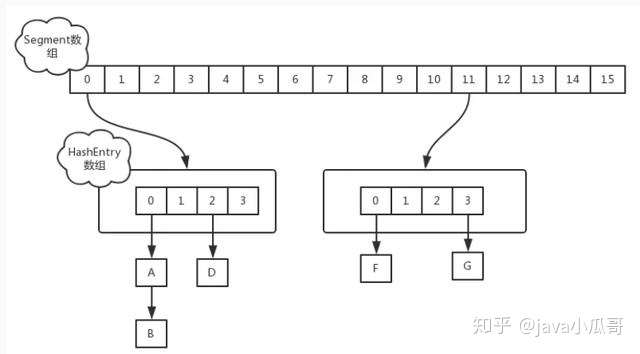
In JDK 1.7, segmented locking is used to implement concurrent update operations. The underlying storage structure is array + linked list, with two core static inner classes: Segment and HashEntry.
SegmentextendsReentrantLockand acts as the lock. EachSegmentobject guards several buckets in the hash table.HashEntryencapsulates a key-value pair in the map.- Each bucket is a linked list made up of multiple
HashEntryobjects.
6. References
Concurrency Talk (Part 4) — In-depth Analysis of ConcurrentHashMap - InfoQ
Discussion
Sign in with GitHub to comment. Discussions are stored as GitHub Issues.View on GitHub