
NOTE
2.4 How the Target Method Is Executed
Invoke Calc.div, enter the proxy intercept method, build the interceptor chain, and execute interceptors plus the target method
This is a historical learning note and may contain outdated or incomplete understanding.
1. Continue the Breakpoints and Execute Calc.div
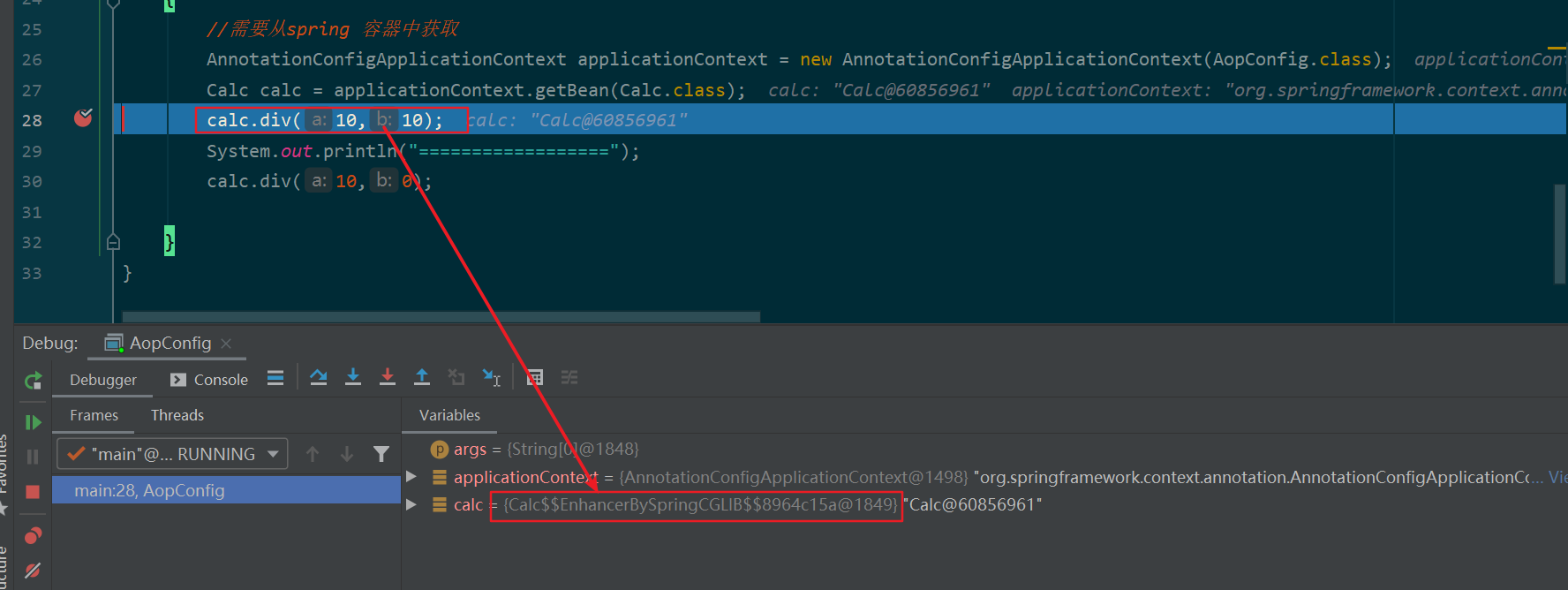
2. Enter the Proxy Object’s intercept Method
CglibAopProxy.DynamicAdvisedInterceptor#intercept
public Object intercept(Object proxy, Method method, Object[] args, MethodProxy methodProxy) throws Throwable {
    Object oldProxy = null;
    boolean setProxyContext = false;
    Class<?> targetClass = null;
    Object target = null;
    try {
        if (this.advised.exposeProxy) {
            // Make invocation available if necessary.
            oldProxy = AopContext.setCurrentProxy(proxy);
            setProxyContext = true;
        }
        // Obtain the target class.
        target = getTarget();
        if (target != null) {
            targetClass = target.getClass();
        }
        // Obtain the interceptor chain.
        List<Object> chain = this.advised.getInterceptorsAndDynamicInterceptionAdvice(method, targetClass);
        Object retVal;
        // Check whether we only have one InvokerInterceptor: that is,
        // no real advice, but just reflective invocation of the target.
        if (chain.isEmpty() && Modifier.isPublic(method.getModifiers())) {
            // We can skip creating a MethodInvocation: just invoke the target directly.
            // Note that the final invoker must be an InvokerInterceptor, so we know
            // it does nothing but a reflective operation on the target, and no hot
            // swapping or fancy proxying.
            Object[] argsToUse = AopProxyUtils.adaptArgumentsIfNecessary(method, args);
            retVal = methodProxy.invoke(target, argsToUse);
        }
        else {
            // If there is an interceptor chain, wrap it in CglibMethodInvocation
            // and call proceed.
            retVal = new CglibMethodInvocation(proxy, target, method, args, targetClass, chain, methodProxy).proceed();
        }
        // If there is no interceptor chain, the target method was executed directly above.
        retVal = processReturnType(proxy, target, method, retVal);
        return retVal;
    }
    finally {
        if (target != null) {
            releaseTarget(target);
        }
        if (setProxyContext) {
            // Restore old proxy.
            AopContext.setCurrentProxy(oldProxy);
        }
    }
}
2.1. Obtain the Interceptor Chain
AdvisedSupport#getInterceptorsAndDynamicInterceptionAdvice
public List<Object> getInterceptorsAndDynamicInterceptionAdvice(Method method, Class<?> targetClass) {
    MethodCacheKey cacheKey = new MethodCacheKey(method);
    List<Object> cached = this.methodCache.get(cacheKey);
    if (cached == null) {
        // Obtain all advisors: one default advisor and four of ours.
        cached = this.advisorChainFactory.getInterceptorsAndDynamicInterceptionAdvice(
                this, method, targetClass);
        this.methodCache.put(cacheKey, cached);
    }
    return cached;
}
2.1.1. Convert Advisors into Interceptors
DefaultAdvisorChainFactory#getInterceptorsAndDynamicInterceptionAdvice
public List<Object> getInterceptorsAndDynamicInterceptionAdvice(
        Advised config, Method method, Class<?> targetClass) {
    // Iterate over all advisors and convert them into Interceptors.
    // This is somewhat tricky... We have to process introductions first,
    // but we need to preserve order in the ultimate list.
    List<Object> interceptorList = new ArrayList<Object>(config.getAdvisors().length);
    Class<?> actualClass = (targetClass != null ? targetClass : method.getDeclaringClass());
    boolean hasIntroductions = hasMatchingIntroductions(config, actualClass);
    AdvisorAdapterRegistry registry = GlobalAdvisorAdapterRegistry.getInstance();

    for (Advisor advisor : config.getAdvisors()) {
        if (advisor instanceof PointcutAdvisor) {
            // Add it conditionally.
            PointcutAdvisor pointcutAdvisor = (PointcutAdvisor) advisor;
            if (config.isPreFiltered() || pointcutAdvisor.getPointcut().getClassFilter().matches(actualClass)) {
                MethodMatcher mm = pointcutAdvisor.getPointcut().getMethodMatcher();
                if (MethodMatchers.matches(mm, method, actualClass, hasIntroductions)) {
                    MethodInterceptor[] interceptors = registry.getInterceptors(advisor);
                    if (mm.isRuntime()) {
                        // Creating a new object instance in the getInterceptors() method
                        // isn't a problem as we normally cache
                        for (MethodInterceptor interceptor : interceptors) {
                            interceptorList.add(new InterceptorAndDynamicMethodMatcher(interceptor, mm));
                        }
                    }
                    else {
                        interceptorList.addAll(Arrays.asList(interceptors));
                    }
                }
            }
        }
        else if (advisor instanceof IntroductionAdvisor) {
            IntroductionAdvisor ia = (IntroductionAdvisor) advisor;
            if (config.isPreFiltered() || ia.getClassFilter().matches(actualClass)) {
                Interceptor[] interceptors = registry.getInterceptors(advisor);
                interceptorList.addAll(Arrays.asList(interceptors));
            }
        }
        else {
            Interceptor[] interceptors = registry.getInterceptors(advisor);
            interceptorList.addAll(Arrays.asList(interceptors));
        }
    }

    return interceptorList;
}
2.2. If Interceptors Exist, Execute the Interceptors and the Target Method
ReflectiveMethodInvocation#proceed
public Object proceed() throws Throwable {
    // We start with an index of -1 and increment early.
    // currentInterceptorIndex indicates which interceptor is currently being executed, starting from -1.
    // interceptorsAndDynamicMethodMatchers contains all interceptors.
    // If there are no interceptors, invokeJoinpoint is executed, which is the target method.
    // Or, after all interceptors have been executed, invokeJoinpoint is executed, which is the target method.
    if (this.currentInterceptorIndex == this.interceptorsAndDynamicMethodMatchers.size() - 1) {
        return invokeJoinpoint();
    }

    // Execute interceptor 0.
    Object interceptorOrInterceptionAdvice =
            this.interceptorsAndDynamicMethodMatchers.get(++this.currentInterceptorIndex);
    if (interceptorOrInterceptionAdvice instanceof InterceptorAndDynamicMethodMatcher) {
        // Evaluate dynamic method matcher here: static part will already have
        // been evaluated and found to match.
        InterceptorAndDynamicMethodMatcher dm =
                (InterceptorAndDynamicMethodMatcher) interceptorOrInterceptionAdvice;
        if (dm.methodMatcher.matches(this.method, this.targetClass, this.arguments)) {
            return dm.interceptor.invoke(this);
        }
        else {
            // Dynamic matching failed.
            // Skip this interceptor and invoke the next in the chain.
            return proceed();
        }
    }
    else {
        // It's an interceptor, so we just invoke it: The pointcut will have
        // been evaluated statically before this object was constructed.
        // Execution reaches here next.
        return ((MethodInterceptor) interceptorOrInterceptionAdvice).invoke(this);
    }
}
org.springframework.aop.interceptor.ExposeInvocationInterceptor#invoke
public Object invoke(MethodInvocation mi) throws Throwable {
    MethodInvocation oldInvocation = invocation.get();
    invocation.set(mi);
    try {
        // Execute org.springframework.aop.framework.ReflectiveMethodInvocation#proceed again.
        // This is recursion.
        return mi.proceed();
    }
    finally {
        invocation.set(oldInvocation);
    }
}
2.2.1. The Final Execution Order Is
ExposeInvocationInterceptor (6)
AspectJAfterThrowingAdvice (5)
AfterReturningAdviceInterceptor (4)
AspectJAfterAdvice (3)
MethodBeforeAdviceInterceptor (1)
Target method (2)
Discussion
Sign in with GitHub to comment. Discussions are stored as GitHub Issues.View on GitHub