
NOTE
Tomcat Request Processing: Source View
Sequence diagram and source tracing from NioEndpoint accept/poll processing through SocketProcessor, Processor, CoyoteAdapter, valves, filters, and servlet invocation.
This is a historical learning note and may contain outdated or incomplete understanding.
Sequence Diagram
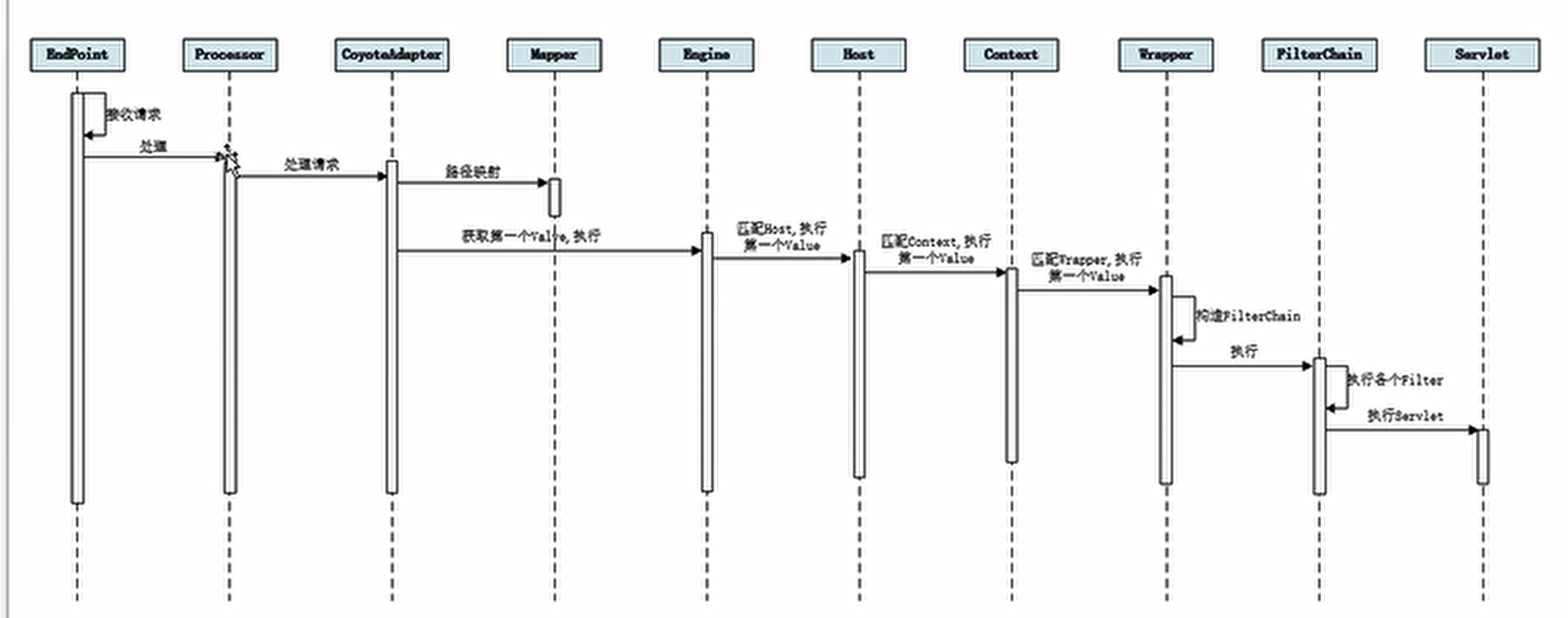
Source Tracing
According to Startup Flow, Tomcat startup has two main steps: one is init, and the other is start.
The main work of init is binding the port (bind), while the main work of start is listening for client connections (accept).
The code that listens for client connections is in the following logic.
NioEndpoint
startInternal
public void startInternal() throws Exception {

    if (!running) {
        running = true;
        paused = false;

        processorCache = new SynchronizedStack<>(SynchronizedStack.DEFAULT_SIZE,
                socketProperties.getProcessorCache());
        eventCache = new SynchronizedStack<>(SynchronizedStack.DEFAULT_SIZE,
                        socketProperties.getEventCache());
        nioChannels = new SynchronizedStack<>(SynchronizedStack.DEFAULT_SIZE,
                socketProperties.getBufferPool());

        // Create a thread pool as workers to process requests whose connections have already been established
        if ( getExecutor() == null ) {
            createExecutor();
        }

        initializeConnectionLatch();

        // Need to understand the relationship between poller and acceptor
        // Connections accepted by acceptor are wrapped and handed to poller;
        // poller calls workers in the thread pool to process the connection
        pollers = new Poller[getPollerThreadCount()];
        for (int i=0; i<pollers.length; i++) {
            pollers[i] = new Poller();
            Thread pollerThread = new Thread(pollers[i], getName() + "-ClientPoller-"+i);
            pollerThread.setPriority(threadPriority);
            pollerThread.setDaemon(true);
            pollerThread.start();
        }
        // Acceptor threads are used to receive client connection requests
        // org.apache.tomcat.util.net.AbstractEndpoint#startAcceptorThreads
        startAcceptorThreads();
    }
}

protected final void startAcceptorThreads() {
    int count = getAcceptorThreadCount();
    acceptors = new Acceptor[count];

    for (int i = 0; i < count; i++) {
        // The created Acceptor is a Runnable instance
        // org.apache.tomcat.util.net.NioEndpoint.Acceptor
        acceptors[i] = createAcceptor();
        String threadName = getName() + "-Acceptor-" + i;
        acceptors[i].setThreadName(threadName);
        Thread t = new Thread(acceptors[i], threadName);
        t.setPriority(getAcceptorThreadPriority());
        t.setDaemon(getDaemon());
        t.start();// Start this Runnable
    }
}
Acceptor
Acceptor.run
protected class Acceptor extends AbstractEndpoint.Acceptor {

    @Override
    public void run() {

        int errorDelay = 0;

        // Loop until we receive a shutdown command
        while (running) {

            // Loop if endpoint is paused
            while (paused && running) {
                state = AcceptorState.PAUSED;
                try {
                    Thread.sleep(50);
                } catch (InterruptedException e) {
                    // Ignore
                }
            }

            if (!running) {
                break;
            }
            state = AcceptorState.RUNNING;

            try {
                //if we have reached max connections, wait
                countUpOrAwaitConnection();

                SocketChannel socket = null;
                try {
                    // Block and wait for a client connection
                    socket = serverSock.accept();
                } catch (IOException ioe) {
                    // We didn't get a socket
                    countDownConnection();
                    if (running) {
                        // Introduce delay if necessary
                        errorDelay = handleExceptionWithDelay(errorDelay);
                        // re-throw
                        throw ioe;
                    } else {
                        break;
                    }
                }
                // Successful accept, reset the error delay
                errorDelay = 0;

                // Configure the socket
                if (running && !paused) {
                    // Hand the socket to poller for processing
                    //getPoller0().register(channel);

                    if (!setSocketOptions(socket)) {
                        closeSocket(socket);
                    }
                } else {
                    closeSocket(socket);
                }
            } catch (Throwable t) {
                ExceptionUtils.handleThrowable(t);
                log.error(sm.getString("endpoint.accept.fail"), t);
            }
        }
        state = AcceptorState.ENDED;
    }


}
Set a breakpoint in org.apache.tomcat.util.net.NioEndpoint.Acceptor.run. Any client connection that arrives passes through this logic.
After that, the socket is handed to Poller for processing. We continue by studying Poller.
Poller
Poller is also a Runnable. It continuously checks whether new events have arrived and processes them if there are any.
Poller.run
public void run() {
    // Loop until destroy() is called
    while (true) {

        boolean hasEvents = false;

        try {
            if (!close) {
                hasEvents = events();
                if (wakeupCounter.getAndSet(-1) > 0) {
                    //if we are here, means we have other stuff to do
                    //do a non blocking select
                    keyCount = selector.selectNow();
                } else {
                    keyCount = selector.select(selectorTimeout);
                }
                wakeupCounter.set(0);
            }
            if (close) {
                events();
                timeout(0, false);
                try {
                    selector.close();
                } catch (IOException ioe) {
                    log.error(sm.getString("endpoint.nio.selectorCloseFail"), ioe);
                }
                break;
            }
        } catch (Throwable x) {
            ExceptionUtils.handleThrowable(x);
            log.error("",x);
            continue;
        }
        //either we timed out or we woke up, process events first
        if ( keyCount == 0 ) hasEvents = (hasEvents | events());

        // Traverse all events
        Iterator<SelectionKey> iterator =
            keyCount > 0 ? selector.selectedKeys().iterator() : null;
        // Walk through the collection of ready keys and dispatch
        // any active event.
        while (iterator != null && iterator.hasNext()) {
            SelectionKey sk = iterator.next();
            NioSocketWrapper attachment = (NioSocketWrapper)sk.attachment();
            // Attachment may be null if another thread has called
            // cancelledKey()
            if (attachment == null) {
                iterator.remove();
            } else {
                iterator.remove();
                // Process it
                processKey(sk, attachment);
            }
        }//while

        //process timeouts
        timeout(keyCount,hasEvents);
    }//while

    getStopLatch().countDown();
}
processKey
protected void processKey(SelectionKey sk, NioSocketWrapper attachment) {
    try {
        if ( close ) {
            cancelledKey(sk);
        } else if ( sk.isValid() && attachment != null ) {
            if (sk.isReadable() || sk.isWritable() ) {
                if ( attachment.getSendfileData() != null ) {
                    processSendfile(sk,attachment, false);
                } else {
                    unreg(sk, attachment, sk.readyOps());
                    boolean closeSocket = false;
                    // Read goes before write
                    if (sk.isReadable()) {
                        // Process a read event
                        if (!processSocket(attachment, SocketEvent.OPEN_READ, true)) {
                            closeSocket = true;
                        }
                    }
                    if (!closeSocket && sk.isWritable()) {
                        // Process a write event
                        if (!processSocket(attachment, SocketEvent.OPEN_WRITE, true)) {
                            closeSocket = true;
                        }
                    }
                    if (closeSocket) {
                        cancelledKey(sk);
                    }
                }
            }
        } else {
            //invalid key
            cancelledKey(sk);
        }
    } catch ( CancelledKeyException ckx ) {
        cancelledKey(sk);
    } catch (Throwable t) {
        ExceptionUtils.handleThrowable(t);
        log.error("",t);
    }
}
processSocket
public boolean processSocket(SocketWrapperBase<S> socketWrapper,
        SocketEvent event, boolean dispatch) {
    try {
        if (socketWrapper == null) {
            return false;
        }
        SocketProcessorBase<S> sc = processorCache.pop();
        if (sc == null) {
            // Wrap the socket event as SocketProcessorBase
            sc = createSocketProcessor(socketWrapper, event);
        } else {
            sc.reset(socketWrapper, event);
        }
        Executor executor = getExecutor();
        if (dispatch && executor != null) {
            // Use the thread pool to process SocketProcessorBase
            executor.execute(sc);
        } else {
            sc.run();
        }
    } catch (RejectedExecutionException ree) {
        getLog().warn(sm.getString("endpoint.executor.fail", socketWrapper) , ree);
        return false;
    } catch (Throwable t) {
        ExceptionUtils.handleThrowable(t);
        // This means we got an OOM or similar creating a thread, or that
        // the pool and its queue are full
        getLog().error(sm.getString("endpoint.process.fail"), t);
        return false;
    }
    return true;
}
SocketProcessorBase
This is also a Runnable. Look at org.apache.tomcat.util.net.NioEndpoint.SocketProcessor#doRun.
protected void doRun() {
    NioChannel socket = socketWrapper.getSocket();
    SelectionKey key = socket.getIOChannel().keyFor(socket.getPoller().getSelector());

    try {
        int handshake = -1;

        try {
            if (key != null) {
                // Related to the TCP handshake
                if (socket.isHandshakeComplete()) {
                    // No TLS handshaking required. Let the handler
                    // process this socket / event combination.
                    handshake = 0;
                } else if (event == SocketEvent.STOP || event == SocketEvent.DISCONNECT ||
                        event == SocketEvent.ERROR) {
                    // Unable to complete the TLS handshake. Treat it as
                    // if the handshake failed.
                    handshake = -1;
                } else {
                    handshake = socket.handshake(key.isReadable(), key.isWritable());
                    // The handshake process reads/writes from/to the
                    // socket. status may therefore be OPEN_WRITE once
                    // the handshake completes. However, the handshake
                    // happens when the socket is opened so the status
                    // must always be OPEN_READ after it completes. It
                    // is OK to always set this as it is only used if
                    // the handshake completes.
                    event = SocketEvent.OPEN_READ;
                }
            }
        } catch (IOException x) {
            handshake = -1;
            if (log.isDebugEnabled()) log.debug("Error during SSL handshake",x);
        } catch (CancelledKeyException ckx) {
            handshake = -1;
        }
        if (handshake == 0) {
            SocketState state = SocketState.OPEN;
            // Process the request from this socket
            if (event == null) {
                // The important part is this call to org.apache.coyote.AbstractProtocol.ConnectionHandler#process
                // Then it calls org.apache.coyote.AbstractProcessorLight#process
                state = getHandler().process(socketWrapper, SocketEvent.OPEN_READ);
            } else {
                state = getHandler().process(socketWrapper, event);
            }
            if (state == SocketState.CLOSED) {
                close(socket, key);
            }
        } else if (handshake == -1 ) {
            getHandler().process(socketWrapper, SocketEvent.CONNECT_FAIL);
            close(socket, key);
        } else if (handshake == SelectionKey.OP_READ){
            socketWrapper.registerReadInterest();
        } else if (handshake == SelectionKey.OP_WRITE){
            socketWrapper.registerWriteInterest();
        }
    } catch (CancelledKeyException cx) {
        socket.getPoller().cancelledKey(key);
    } catch (VirtualMachineError vme) {
        ExceptionUtils.handleThrowable(vme);
    } catch (Throwable t) {
        log.error("", t);
        socket.getPoller().cancelledKey(key);
    } finally {
        socketWrapper = null;
        event = null;
        //return to cache
        if (running && !paused) {
            processorCache.push(this);
        }
    }
}
Processor
public SocketState process(SocketWrapperBase<?> socketWrapper, SocketEvent status)
        throws IOException {

        //...
        // Call org.apache.coyote.http11.Http11Processor#service
        // Parse the request into HTTP request and response
        // Then call getAdapter().service(request, response);
        // That is, hand request and response to the Container through the Adapter
        state = service(socketWrapper);
        //...
}
CoyoteAdapter
service
public void service(org.apache.coyote.Request req, org.apache.coyote.Response res)
            throws Exception {
    // The key code is this section.
    // First call org.apache.catalina.core.StandardEngineValve#invoke
    // then org.apache.catalina.core.StandardHostValve#invoke
    // then org.apache.catalina.core.StandardContextValve#invoke
    // and finally org.apache.catalina.core.StandardWrapperValve#invoke
    connector.getService().getContainer().getPipeline().getFirst().invoke(
                            request, response);
}
StandardWrapperValve
 public final void invoke(Request request, Response response)
    throws IOException, ServletException {


    // Finally, the familiar Servlet appears
    Servlet servlet = null;

        if (!unavailable) {
            // Create the servlet instance through reflection
            // Also calls servlet.init(facade);
            servlet = wrapper.allocate();

    // Wrap servlet and filter together
    ApplicationFilterChain filterChain =
            ApplicationFilterFactory.createFilterChain(request, wrapper, servlet);

    // Call both servlet and filter
    // Eventually calls org.apache.catalina.core.ApplicationFilterChain#internalDoFilter
    filterChain.doFilter(request.getRequest(),
            response.getResponse());

    // Put it back into the Servlet pool and wake it up?? Rather than calling destroy?
    wrapper.deallocate(servlet);

}
ApplicationFilterChain
internalDoFilter
private void internalDoFilter(ServletRequest request,
                              ServletResponse response)
    throws IOException, ServletException {

    // Call filter
    filter.doFilter(request, response, this);


            // Finally call the servlet's service method
            // It calls javax.servlet.http.HttpServlet#service(javax.servlet.ServletRequest, javax.servlet.ServletResponse)
            // javax.servlet.http.HttpServlet#service(javax.servlet.http.HttpServletRequest, javax.servlet.http.HttpServletResponse)
            // Then calls the doXXX method
            servlet.service(request, response);


}
Discussion
Sign in with GitHub to comment. Discussions are stored as GitHub Issues.View on GitHub