
NOTE
Spring Transaction Source Analysis
1. Enable transaction management. 2. TransactionManagementConfigurationSelector imports AutoProxyRegistrar and ProxyTransactionManagementConfiguration. 3. Study AutoProxyRegistrar. 4. Study ProxyTransactionManagementConfiguration and transaction interception.
This is a historical learning note and may contain outdated or incomplete understanding.
1. Enable Transaction Management Annotation
@EnableTransactionManagement
@Target(ElementType.TYPE)
@Retention(RetentionPolicy.RUNTIME)
@Documented
@Import(TransactionManagementConfigurationSelector.class)// Imports TransactionManagementConfigurationSelector
public @interface EnableTransactionManagement {

    boolean proxyTargetClass() default false;

    AdviceMode mode() default AdviceMode.PROXY;

    int order() default Ordered.LOWEST_PRECEDENCE;

}
This annotation imports TransactionManagementConfigurationSelector into the Spring container. We continue by studying it.
2. TransactionManagementConfigurationSelector Imports AutoProxyRegistrar and ProxyTransactionManagementConfiguration into the Container
TransactionManagementConfigurationSelector.selectImports
@Override
protected String[] selectImports(AdviceMode adviceMode) {
    // The mode parameter of EnableTransactionManagement; the default is PROXY
    switch (adviceMode) {
        case PROXY:
            // Import AutoProxyRegistrar and ProxyTransactionManagementConfiguration
            return new String[] {AutoProxyRegistrar.class.getName(),
                    ProxyTransactionManagementConfiguration.class.getName()};
        case ASPECTJ:
            return new String[] {
                    TransactionManagementConfigUtils.TRANSACTION_ASPECT_CONFIGURATION_CLASS_NAME};
        default:
            return null;
    }
}
2.1. When Is ImportSelector.selectImports Called?
Set a breakpoint at TransactionManagementConfigurationSelector#selectImports. The debug call stack is as follows:
selectImports:45, TransactionManagementConfigurationSelector (org.springframework.transaction.annotation)
selectImports:74, AdviceModeImportSelector (org.springframework.context.annotation)
processImports:591, ConfigurationClassParser (org.springframework.context.annotation)
doProcessConfigurationClass:304, ConfigurationClassParser (org.springframework.context.annotation)
processConfigurationClass:247, ConfigurationClassParser (org.springframework.context.annotation)
parse:200, ConfigurationClassParser (org.springframework.context.annotation)
parse:169, ConfigurationClassParser (org.springframework.context.annotation)
processConfigBeanDefinitions:308, ConfigurationClassPostProcessor (org.springframework.context.annotation)
postProcessBeanDefinitionRegistry:228, ConfigurationClassPostProcessor (org.springframework.context.annotation)
invokeBeanDefinitionRegistryPostProcessors:272, PostProcessorRegistrationDelegate (org.springframework.context.support)
invokeBeanFactoryPostProcessors:92, PostProcessorRegistrationDelegate (org.springframework.context.support)
invokeBeanFactoryPostProcessors:687, AbstractApplicationContext (org.springframework.context.support)
refresh:524, AbstractApplicationContext (org.springframework.context.support)
<init>:84, AnnotationConfigApplicationContext (org.springframework.context.annotation)
main:48, DbConfig (com.zsk.transaction)
Just like 1. Inject the AspectJAnnotationAutoProxyCreator Component into the Container — tracing ConfigurationClassPostProcessor.postProcessBeanDefinitionRegistry, it is also processed in ConfigurationClassPostProcessor.postProcessBeanDefinitionRegistry.
ConfigurationClassPostProcessor#processConfigBeanDefinitions
public void processConfigBeanDefinitions(BeanDefinitionRegistry registry) {
    //...
    do {
        // ImportSelector.selectImports is called here
        parser.parse(candidates);
        parser.validate();

        Set<ConfigurationClass> configClasses = new LinkedHashSet<ConfigurationClass>(parser.getConfigurationClasses());
        configClasses.removeAll(alreadyParsed);

        // Read the model and create bean definitions based on its content
        if (this.reader == null) {
            this.reader = new ConfigurationClassBeanDefinitionReader(
                    registry, this.sourceExtractor, this.resourceLoader, this.environment,
                    this.importBeanNameGenerator, parser.getImportRegistry());
        }
        // ImportBeanDefinitionRegistrar.registerBeanDefinitions is called here
        this.reader.loadBeanDefinitions(configClasses);
        //...
}
3. First Study AutoProxyRegistrar
3.1. Register InfrastructureAdvisorAutoProxyCreator in the Container: Used to Create Proxy Objects
3.1.1. Class Diagram
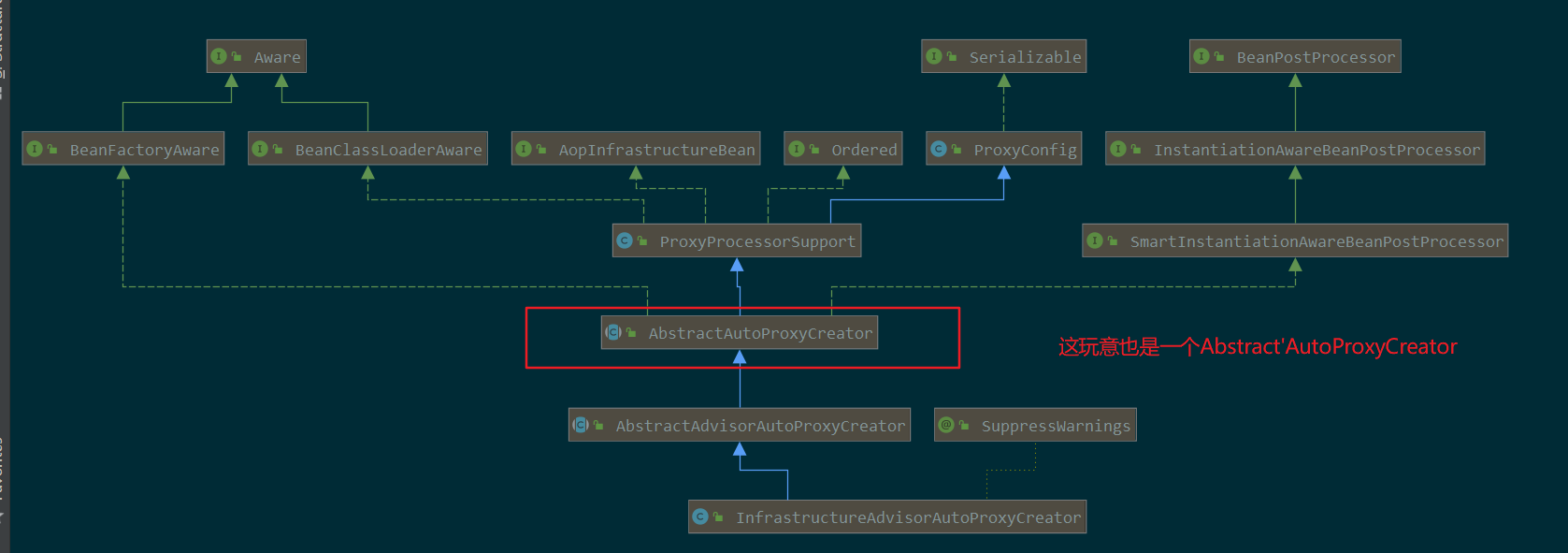
InfrastructureAdvisorAutoProxyCreator is a core part of Spring AOP. See 1. Inject the AspectJAnnotationAutoProxyCreator Component into the Container.
registerBeanDefinitions
public void registerBeanDefinitions(AnnotationMetadata importingClassMetadata, BeanDefinitionRegistry registry) {
    boolean candidateFound = false;
    Set<String> annTypes = importingClassMetadata.getAnnotationTypes();
    for (String annType : annTypes) {
        AnnotationAttributes candidate = AnnotationConfigUtils.attributesFor(importingClassMetadata, annType);
        if (candidate == null) {
            continue;
        }
        // Get the mode and proxyTargetClass properties from EnableTransactionManagement
        Object mode = candidate.get("mode");
        Object proxyTargetClass = candidate.get("proxyTargetClass");
        if (mode != null && proxyTargetClass != null && AdviceMode.class == mode.getClass() &&
                Boolean.class == proxyTargetClass.getClass()) {
            candidateFound = true;
            // The mode property is PROXY
            if (mode == AdviceMode.PROXY) {
                // Call
                AopConfigUtils.registerAutoProxyCreatorIfNecessary(registry);
                // If the proxyTargetClass property is true
                if ((Boolean) proxyTargetClass) {
                    // Delegate to this method
                    AopConfigUtils.forceAutoProxyCreatorToUseClassProxying(registry);
                    return;
                }
            }
        }
    }
    if (!candidateFound && logger.isWarnEnabled()) {
        String name = getClass().getSimpleName();
        logger.warn(String.format("%s was imported but no annotations were found " +
                "having both 'mode' and 'proxyTargetClass' attributes of type " +
                "AdviceMode and boolean respectively. This means that auto proxy " +
                "creator registration and configuration may not have occurred as " +
                "intended, and components may not be proxied as expected. Check to " +
                "ensure that %s has been @Import'ed on the same class where these " +
                "annotations are declared; otherwise remove the import of %s " +
                "altogether.", name, name, name));
    }
}
registerAutoProxyCreatorIfNecessary
public static BeanDefinition registerAutoProxyCreatorIfNecessary(BeanDefinitionRegistry registry) {
    return registerAutoProxyCreatorIfNecessary(registry, null);
}

public static BeanDefinition registerAutoProxyCreatorIfNecessary(BeanDefinitionRegistry registry, Object source) {
    // Register an InfrastructureAdvisorAutoProxyCreator component in the container.
    // It is also a SmartInstantiationAwareBeanPostProcessor.
    // Essentially, all of them use post-processors to wrap objects after creation and return proxy objects (enhancers).
    // The proxy object uses an interceptor chain when executing methods.
    return registerOrEscalateApcAsRequired(InfrastructureAdvisorAutoProxyCreator.class, registry, source);
}

private static BeanDefinition registerOrEscalateApcAsRequired(Class<?> cls, BeanDefinitionRegistry registry, Object source) {
    Assert.notNull(registry, "BeanDefinitionRegistry must not be null");

    if (registry.containsBeanDefinition(AUTO_PROXY_CREATOR_BEAN_NAME)) {
        BeanDefinition apcDefinition = registry.getBeanDefinition(AUTO_PROXY_CREATOR_BEAN_NAME);
        if (!cls.getName().equals(apcDefinition.getBeanClassName())) {
            int currentPriority = findPriorityForClass(apcDefinition.getBeanClassName());
            int requiredPriority = findPriorityForClass(cls);
            if (currentPriority < requiredPriority) {
                apcDefinition.setBeanClassName(cls.getName());
            }
        }
        return null;
    }

    RootBeanDefinition beanDefinition = new RootBeanDefinition(cls);
    beanDefinition.setSource(source);
    beanDefinition.getPropertyValues().add("order", Ordered.HIGHEST_PRECEDENCE);
    beanDefinition.setRole(BeanDefinition.ROLE_INFRASTRUCTURE);
    registry.registerBeanDefinition(AUTO_PROXY_CREATOR_BEAN_NAME, beanDefinition);
    return beanDefinition;
}
4. Then Study ProxyTransactionManagementConfiguration
@Configuration// A configuration class that injects beans
public class ProxyTransactionManagementConfiguration extends AbstractTransactionManagementConfiguration {

    @Bean(name = TransactionManagementConfigUtils.TRANSACTION_ADVISOR_BEAN_NAME)
    @Role(BeanDefinition.ROLE_INFRASTRUCTURE)
    public BeanFactoryTransactionAttributeSourceAdvisor transactionAdvisor() {
        BeanFactoryTransactionAttributeSourceAdvisor advisor = new BeanFactoryTransactionAttributeSourceAdvisor();
        advisor.setTransactionAttributeSource(transactionAttributeSource());// Set the class that parses @Transactional attributes
        advisor.setAdvice(transactionInterceptor());// Set the transaction interceptor
        advisor.setOrder(this.enableTx.<Integer>getNumber("order"));
        return advisor;
    }

    @Bean
    @Role(BeanDefinition.ROLE_INFRASTRUCTURE)
    public TransactionAttributeSource transactionAttributeSource() {
        // Used to parse attributes inside @Transactional
        return new AnnotationTransactionAttributeSource();
    }

    @Bean
    @Role(BeanDefinition.ROLE_INFRASTRUCTURE)
    public TransactionInterceptor transactionInterceptor() {
        // Create the interceptor
        TransactionInterceptor interceptor = new TransactionInterceptor();
        // Save transaction attribute information
        interceptor.setTransactionAttributeSource(transactionAttributeSource());
        // Save transaction manager information
        if (this.txManager != null) {
            interceptor.setTransactionManager(this.txManager);
        }
        return interceptor;
    }

}
This configuration registers a @Bean BeanFactoryTransactionAttributeSourceAdvisor in the container. This bean contains two beans:
TransactionAttributeSource, used to parse attributes inside@Transactional.TransactionInterceptor, the transaction interceptor.
4.1. Create the Bean Used to Parse @Transactional Attributes: AnnotationTransactionAttributeSource
AnnotationTransactionAttributeSourceconstructor
public AnnotationTransactionAttributeSource(boolean publicMethodsOnly) {
        this.publicMethodsOnly = publicMethodsOnly;
        this.annotationParsers = new LinkedHashSet<TransactionAnnotationParser>(4);
        // Use annotation parsers to parse SpringTransactionAnnotation, JtaTransactionAnnotation, and Ejb3TransactionAnnotation
        this.annotationParsers.add(new SpringTransactionAnnotationParser());
        if (jta12Present) {
            this.annotationParsers.add(new JtaTransactionAnnotationParser());
        }
        if (ejb3Present) {
            this.annotationParsers.add(new Ejb3TransactionAnnotationParser());
        }
    }
4.1.1. How Is It Parsed?
SpringTransactionAnnotationParser.parseTransactionAnnotation
protected TransactionAttribute parseTransactionAnnotation(AnnotationAttributes attributes) {
        RuleBasedTransactionAttribute rbta = new RuleBasedTransactionAttribute();

        // Parse the various attributes inside @Transactional
        Propagation propagation = attributes.getEnum("propagation");
        rbta.setPropagationBehavior(propagation.value());
        Isolation isolation = attributes.getEnum("isolation");
        rbta.setIsolationLevel(isolation.value());
        rbta.setTimeout(attributes.getNumber("timeout").intValue());
        rbta.setReadOnly(attributes.getBoolean("readOnly"));
        rbta.setQualifier(attributes.getString("value"));

        List<RollbackRuleAttribute> rollbackRules = new ArrayList<RollbackRuleAttribute>();
        for (Class<?> rbRule : attributes.getClassArray("rollbackFor")) {
            rollbackRules.add(new RollbackRuleAttribute(rbRule));
        }
        for (String rbRule : attributes.getStringArray("rollbackForClassName")) {
            rollbackRules.add(new RollbackRuleAttribute(rbRule));
        }
        for (Class<?> rbRule : attributes.getClassArray("noRollbackFor")) {
            rollbackRules.add(new NoRollbackRuleAttribute(rbRule));
        }
        for (String rbRule : attributes.getStringArray("noRollbackForClassName")) {
            rollbackRules.add(new NoRollbackRuleAttribute(rbRule));
        }
        rbta.setRollbackRules(rollbackRules);

        return rbta;
    }
4.2. Create the Bean Used to Intercept Transactions: TransactionInterceptor
It is a MethodInterceptor, called before the target method executes.
4.2.1. Transaction Interceptor Invocation
invoke
public Object invoke(final MethodInvocation invocation) throws Throwable {
        // Work out the target class: may be {@code null}.
        // The TransactionAttributeSource should be passed the target class
        // as well as the method, which may be from an interface.
        Class<?> targetClass = (invocation.getThis() != null ? AopUtils.getTargetClass(invocation.getThis()) : null);

        // Adapt to TransactionAspectSupport's invokeWithinTransaction...
        return invokeWithinTransaction(invocation.getMethod(), targetClass, new InvocationCallback() {
            @Override
            public Object proceedWithInvocation() throws Throwable {
                return invocation.proceed();
            }
        });
    }
4.2.1.1. Transaction Creation, Commit/Rollback
TransactionAspectSupport.invokeWithinTransaction
protected Object invokeWithinTransaction(Method method, Class<?> targetClass, final InvocationCallback invocation)
        throws Throwable {

    // If the transaction attribute is null, the method is non-transactional.
    // Get transaction attributes
    final TransactionAttribute txAttr = getTransactionAttributeSource().getTransactionAttribute(method, targetClass);
    // Get PlatformTransactionManager
    final PlatformTransactionManager tm = determineTransactionManager(txAttr);
    final String joinpointIdentification = methodIdentification(method, targetClass, txAttr);

    if (txAttr == null || !(tm instanceof CallbackPreferringPlatformTransactionManager)) {
        // Standard transaction demarcation with getTransaction and commit/rollback calls.
        // Create the transaction
        TransactionInfo txInfo = createTransactionIfNecessary(tm, txAttr, joinpointIdentification);

        Object retVal;
        try {
            // This is an around advice: Invoke the next interceptor in the chain.
            // This will normally result in a target object being invoked.
            // Execute the target method
            retVal = invocation.proceedWithInvocation();
        }
        // If an exception occurs
        catch (Throwable ex) {
            // target invocation exception
            // Roll back using the transaction manager
            completeTransactionAfterThrowing(txInfo, ex);
            throw ex;
        }
        finally {
            cleanupTransactionInfo(txInfo);
        }
        // If there is no exception, commit the transaction using the transaction manager
        commitTransactionAfterReturning(txInfo);
        return retVal;
    }

    else {
        final ThrowableHolder throwableHolder = new ThrowableHolder();

        // It's a CallbackPreferringPlatformTransactionManager: pass a TransactionCallback in.
        try {
            Object result = ((CallbackPreferringPlatformTransactionManager) tm).execute(txAttr,
                    new TransactionCallback<Object>() {
                        @Override
                        public Object doInTransaction(TransactionStatus status) {
                            TransactionInfo txInfo = prepareTransactionInfo(tm, txAttr, joinpointIdentification, status);
                            try {

                                return invocation.proceedWithInvocation();
                            }

                            catch (Throwable ex) {
                                if (txAttr.rollbackOn(ex)) {
                                    // A RuntimeException: will lead to a rollback.
                                    if (ex instanceof RuntimeException) {
                                        throw (RuntimeException) ex;
                                    }
                                    else {
                                        throw new ThrowableHolderException(ex);
                                    }
                                }
                                else {
                                    // A normal return value: will lead to a commit.
                                    throwableHolder.throwable = ex;
                                    return null;
                                }
                            }
                            finally {
                                cleanupTransactionInfo(txInfo);
                            }
                        }
                    });

            // Check result state: It might indicate a Throwable to rethrow.
            if (throwableHolder.throwable != null) {
                throw throwableHolder.throwable;
            }
            return result;
        }
        catch (ThrowableHolderException ex) {
            throw ex.getCause();
        }
        catch (TransactionSystemException ex2) {
            if (throwableHolder.throwable != null) {
                logger.error("Application exception overridden by commit exception", throwableHolder.throwable);
                ex2.initApplicationException(throwableHolder.throwable);
            }
            throw ex2;
        }
        catch (Throwable ex2) {
            if (throwableHolder.throwable != null) {
                logger.error("Application exception overridden by commit exception", throwableHolder.throwable);
            }
            throw ex2;
        }
    }
}
4.2.1.1.1. Determine Which Transaction Manager to Use
determineTransactionManager
protected PlatformTransactionManager determineTransactionManager(TransactionAttribute txAttr) {
    // Do not attempt to lookup tx manager if no tx attributes are set
    if (txAttr == null || this.beanFactory == null) {
        return getTransactionManager();
    }

    String qualifier = txAttr.getQualifier();
    // If specified on the annotation, use the specified TransactionManager
    if (StringUtils.hasText(qualifier)) {
        return determineQualifiedTransactionManager(qualifier);
    }
    else if (StringUtils.hasText(this.transactionManagerBeanName)) {
        return determineQualifiedTransactionManager(this.transactionManagerBeanName);
    }
    // Use the default TransactionManager
    else {
        PlatformTransactionManager defaultTransactionManager = getTransactionManager();
        if (defaultTransactionManager == null) {
            defaultTransactionManager = this.transactionManagerCache.get(DEFAULT_TRANSACTION_MANAGER_KEY);
            if (defaultTransactionManager == null) {
                // Actually just get the PlatformTransactionManager bean from the container
                defaultTransactionManager = this.beanFactory.getBean(PlatformTransactionManager.class);
                this.transactionManagerCache.putIfAbsent(
                        DEFAULT_TRANSACTION_MANAGER_KEY, defaultTransactionManager);
            }
        }
        return defaultTransactionManager;
    }
}
Discussion
Sign in with GitHub to comment. Discussions are stored as GitHub Issues.View on GitHub