
NOTE
Adding and Removing ChannelHandlers
1. Add a handler 2. Remove a handler
This is a historical learning note and may contain outdated or incomplete understanding.
1. Add a Handler
DefaultChannelPipeline#addLast
public final ChannelPipeline addLast(EventExecutorGroup group, String name, ChannelHandler handler) {
    final AbstractChannelHandlerContext newCtx;
    synchronized (this) {
        // Check whether the handler has already been added.
        checkMultiplicity(handler);

        // Create a node and add it to the linked list.
        newCtx = newContext(group, filterName(name, handler), handler);

        addLast0(newCtx);


        if (!registered) {
            newCtx.setAddPending();
            callHandlerCallbackLater(newCtx, true);
            return this;
        }

        EventExecutor executor = newCtx.executor();
        if (!executor.inEventLoop()) {
            newCtx.setAddPending();
            executor.execute(new Runnable() {
                @Override
                public void run() {
                    // Callback after addition completes.
                    callHandlerAdded0(newCtx);
                }
            });
            return this;
        }
    }
    callHandlerAdded0(newCtx);
    return this;
}
1.1. Check Whether It Was Added Repeatedly
checkMultiplicity
private static void checkMultiplicity(ChannelHandler handler) {
    if (handler instanceof ChannelHandlerAdapter) {
        ChannelHandlerAdapter h = (ChannelHandlerAdapter) handler;
        // Non-sharable [meaning it is not one instance per channel] and already added.
        if (!h.isSharable() && h.added) {
            // Throw an exception.
            throw new ChannelPipelineException(
                    h.getClass().getName() +
                    " is not a @Sharable handler, so can't be added or removed multiple times.");
        }
        // Mark it as already added.
        h.added = true;
    }
}
1.2. Create the Node and Add It to the Linked List
newContext
private AbstractChannelHandlerContext newContext(EventExecutorGroup group, String name, ChannelHandler handler) {
    // Call DefaultChannelHandlerContext.
    return new DefaultChannelHandlerContext(this, childExecutor(group), name, handler);
}
DefaultChannelHandlerContext
DefaultChannelHandlerContext(
        DefaultChannelPipeline pipeline, EventExecutor executor, String name, ChannelHandler handler) {
    super(pipeline, executor, name, isInbound(handler), isOutbound(handler));
    if (handler == null) {
        throw new NullPointerException("handler");
    }
    this.handler = handler;
}
addLast0
private void addLast0(AbstractChannelHandlerContext newCtx) {
    // Add it before tail.
    AbstractChannelHandlerContext prev = tail.prev;
    newCtx.prev = prev;
    newCtx.next = tail;
    prev.next = newCtx;
    tail.prev = newCtx;
}
1.3. Callback After Addition Completes
callHandlerAdded0
private void callHandlerAdded0(final AbstractChannelHandlerContext ctx) {
    try {

        ctx.setAddComplete();
        // Callback into user code: io.netty.channel.ChannelInitializer#handlerAdded
        ctx.handler().handlerAdded(ctx);
    //。。。。。。。。。
}
io.netty.channel.ChannelInitializer#handlerAdded
public void handlerAdded(ChannelHandlerContext ctx) throws Exception {
    if (ctx.channel().isRegistered()) {
        // This should always be true with our current DefaultChannelPipeline implementation.
        // The good thing about calling initChannel(...) in handlerAdded(...) is that there will be no ordering
        // surprises if a ChannelInitializer will add another ChannelInitializer. This is as all handlers
        // will be added in the expected order.
        initChannel(ctx);
    }
}
initChannel
private boolean initChannel(ChannelHandlerContext ctx) throws Exception {
    if (initMap.putIfAbsent(ctx, Boolean.TRUE) == null) { // Guard against re-entrance.
        try {
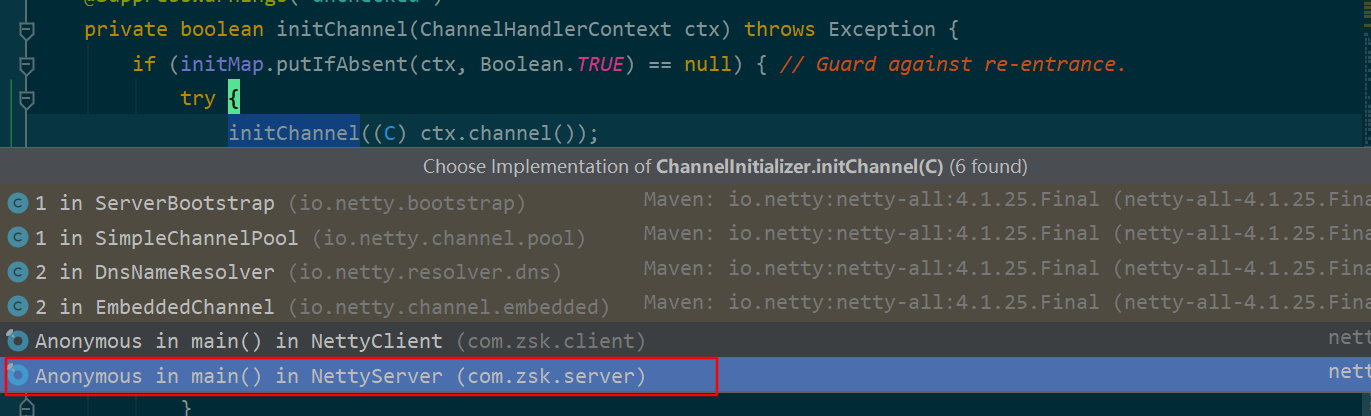
            // Callback into user code, as shown below.
            initChannel((C) ctx.channel());
        } catch (Throwable cause) {
            // Explicitly call exceptionCaught(...) as we removed the handler before calling initChannel(...).
            // We do so to prevent multiple calls to initChannel(...).
            exceptionCaught(ctx, cause);
        } finally {
            remove(ctx);
        }
        return true;
    }
    return false;
}
2. Remove a Handler
2.1. Usage Scenario
For example, after user password verification is complete, the handler needs to be removed.
remove
public final ChannelPipeline remove(ChannelHandler handler) {
    remove(getContextOrDie(handler));
    return this;
}
First use getContextOrDie to find the corresponding node, then call remove to delete that node.
2.2. Find the Node
private AbstractChannelHandlerContext getContextOrDie(ChannelHandler handler) {
    AbstractChannelHandlerContext ctx = (AbstractChannelHandlerContext) context(handler);
    if (ctx == null) {
        throw new NoSuchElementException(handler.getClass().getName());
    } else {
        return ctx;
    }
}
Call context to find the node and cast it to AbstractChannelHandlerContext. If it is null, a NoSuchElementException is thrown.
context
public final ChannelHandlerContext context(ChannelHandler handler) {
    if (handler == null) {
        throw new NullPointerException("handler");
    }

    AbstractChannelHandlerContext ctx = head.next;
    for (;;) {

        if (ctx == null) {
            return null;
        }

        if (ctx.handler() == handler) {
            return ctx;
        }

        ctx = ctx.next;
    }
}
It simply starts from head and traverses the list until it finds a node whose handler() == handler.
2.3. Remove the Node
private AbstractChannelHandlerContext remove(final AbstractChannelHandlerContext ctx) {
    assert ctx != head && ctx != tail;

    // Locking is required.
    synchronized (this) {
        remove0(ctx);

        // If the registered is false it means that the channel was not registered on an eventloop yet.
        // In this case we remove the context from the pipeline and add a task that will call
        // ChannelHandler.handlerRemoved(...) once the channel is registered.
        if (!registered) {
            callHandlerCallbackLater(ctx, false);
            return ctx;
        }

        EventExecutor executor = ctx.executor();
        if (!executor.inEventLoop()) {
            executor.execute(new Runnable() {
                @Override
                public void run() {
                    callHandlerRemoved0(ctx);
                }
            });
            return ctx;
        }
    }
    callHandlerRemoved0(ctx);
    return ctx;
}
During deletion, it first acquires the lock, then calls remove0 to unlink the node from the list, and finally calls back handlerRemoved through callHandlerRemoved.
2.3.1. Remove It from the Linked List
private static void remove0(AbstractChannelHandlerContext ctx) {
    AbstractChannelHandlerContext prev = ctx.prev;
    AbstractChannelHandlerContext next = ctx.next;
    prev.next = next;
    next.prev = prev;
}
Only the pointers need to be changed. Because head and tail are guaranteed to exist, the operation is much simpler.
2.3.2. Callback to handlerRemoved
private void callHandlerRemoved0(final AbstractChannelHandlerContext ctx) {
    // Notify the complete removal.
    try {
        try {
            ctx.handler().handlerRemoved(ctx);
        } finally {
            ctx.setRemoved();
        }
    } catch (Throwable t) {
        fireExceptionCaught(new ChannelPipelineException(
                ctx.handler().getClass().getName() + ".handlerRemoved() has thrown an exception.", t));
    }
}
Discussion
Sign in with GitHub to comment. Discussions are stored as GitHub Issues.View on GitHub