
NOTE
ByteBuf
Data structure, API, class hierarchy, and classification
This is a historical learning note and may contain outdated or incomplete understanding.
Data Structure
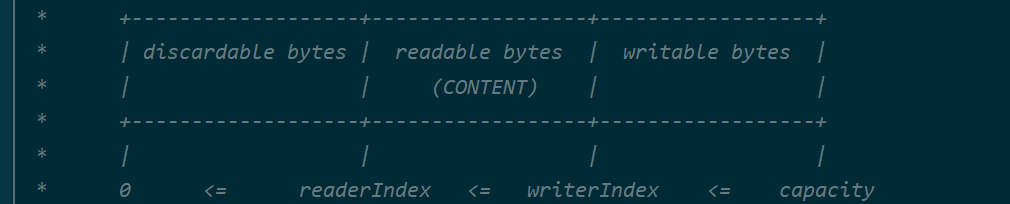
There are two indexes: one marks the read position and one marks the write position.
0 < read < write < capacity
Data between 0 and the read index is invalid, data between the read and write indexes is readable, and data between the write index and capacity is writable.
API
readXXX reads data and moves the read index backward through the buffer.
writeXXX writes data and moves the write index backward through the buffer.
set does not move an index; it only changes data.
mark records the current read-index position so that it can later be restored through reset.
Class Hierarchy
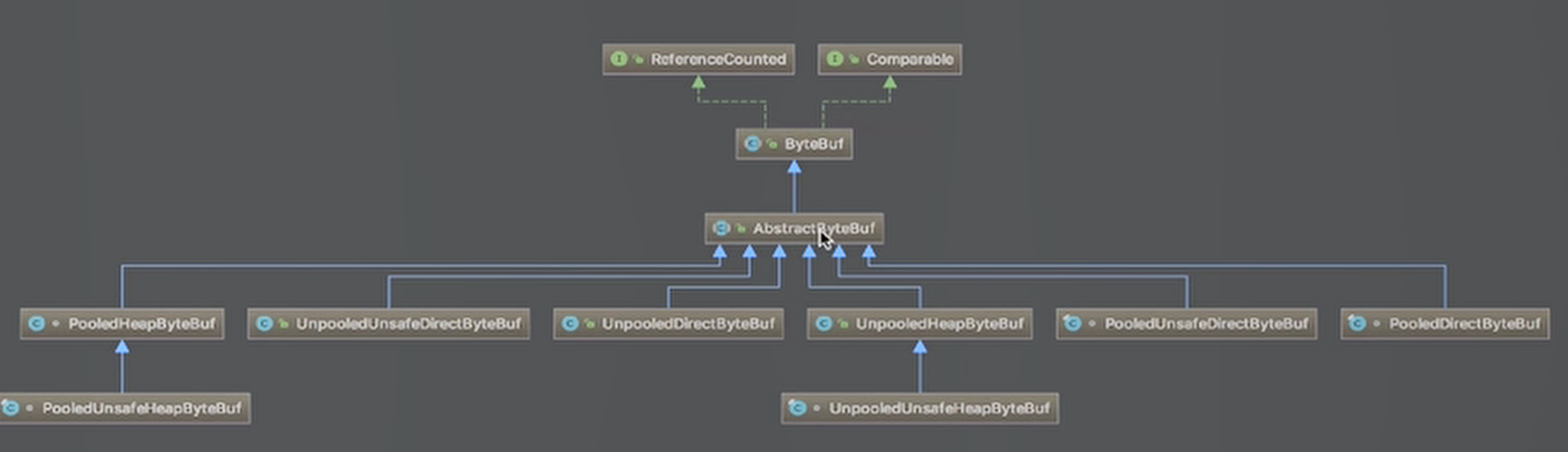
ByteBuf consists of abstract methods.
AbstractByteBuf provides some basic skeleton implementations.
- For example,
getByte
It checks whether the index is valid and then calls the subclass implementation of _getByte.
@Override
public byte getByte(int index) {
    checkIndex(index);
    return _getByte(index);
}

protected abstract byte _getByte(int index);
Classification
It can mainly be classified along three dimensions.
pooled and unpooled
Whether the data is operated on in preallocated memory.
unsafe and non-unsafe
Whether JDK low-level NIO operations are used.
Using PooledUnsafeHeapByteBuf as an example, look at its _getByte method:
protected byte _getByte(int index) {
    return UnsafeByteBufUtil.getByte(memory, idx(index));
}

static byte getByte(byte[] array, int index) {
    return PlatformDependent.getByte(array, index);
}

public static byte getByte(byte[] data, int index) {
    return PlatformDependent0.getByte(data, index);
}

static byte getByte(byte[] data, int index) {
    // Finally calls Unsafe.
    return UNSAFE.getByte(data, BYTE_ARRAY_BASE_OFFSET + index);
}
Compare it with PooledHeapByteBuf._getByte:
protected byte _getByte(int index) {
    return HeapByteBufUtil.getByte(memory, idx(index));
}

static byte getByte(byte[] memory, int index) {
    // Does not call Unsafe; reads the array directly.
    return memory[index];
}
heap and direct
Whether the memory is allocated on the JVM heap or directly in OS memory.
Using UnPooledHeapByteBuf.getByte as an example:
public byte getByte(int index) {
    ensureAccessible();
    return _getByte(index);
}

protected byte _getByte(int index) {
    return HeapByteBufUtil.getByte(array, index);
}

static byte getByte(byte[] memory, int index) {
    // Reads from an array, so this is on the heap.
    return memory[index];
}
Compare it with UnPooledDirectByteBuf:
public byte getByte(int index) {
    ensureAccessible();
    return _getByte(index);
}


protected byte _getByte(int index) {
    // This buffer is a JDK NIO buffer.
    // See Unpooled.directBuffer.
    return buffer.get(index);
}
Unpooled.directBuffer
public static ByteBuf directBuffer(int initialCapacity) {
    return ALLOC.directBuffer(initialCapacity);
}

public ByteBuf directBuffer(int initialCapacity) {
    return directBuffer(initialCapacity, DEFAULT_MAX_CAPACITY);
}

public ByteBuf directBuffer(int initialCapacity, int maxCapacity) {
    if (initialCapacity == 0 && maxCapacity == 0) {
        return emptyBuf;
    }
    validate(initialCapacity, maxCapacity);
    return newDirectBuffer(initialCapacity, maxCapacity);
}

protected ByteBuf newDirectBuffer(int initialCapacity, int maxCapacity) {
    final ByteBuf buf;
    if (PlatformDependent.hasUnsafe()) {
        // Here.
        buf = noCleaner ? new InstrumentedUnpooledUnsafeNoCleanerDirectByteBuf(this, initialCapacity, maxCapacity) :
                new InstrumentedUnpooledUnsafeDirectByteBuf(this, initialCapacity, maxCapacity);
    } else {
        buf = new InstrumentedUnpooledDirectByteBuf(this, initialCapacity, maxCapacity);
    }
    return disableLeakDetector ? buf : toLeakAwareBuffer(buf);
}
//......

public UnpooledUnsafeDirectByteBuf(ByteBufAllocator alloc, int initialCapacity, int maxCapacity) {
    super(maxCapacity);
    if (alloc == null) {
        throw new NullPointerException("alloc");
    }
    if (initialCapacity < 0) {
        throw new IllegalArgumentException("initialCapacity: " + initialCapacity);
    }
    if (maxCapacity < 0) {
        throw new IllegalArgumentException("maxCapacity: " + maxCapacity);
    }
    if (initialCapacity > maxCapacity) {
        throw new IllegalArgumentException(String.format(
                "initialCapacity(%d) > maxCapacity(%d)", initialCapacity, maxCapacity));
    }

    this.alloc = alloc;
    // ByteBuffer.allocateDirect(initialCapacity)
    // JDK low-level NIO allocates direct memory.
    setByteBuffer(allocateDirect(initialCapacity), false);
}
Discussion
Sign in with GitHub to comment. Discussions are stored as GitHub Issues.View on GitHub